
Be the bush
Bad Bunny's orchestrated environment, and a few that I've lived in

Most of us have at least one dream gig that we would sell assets or cross oceans to accept. And now, in the aftermath of Super Bowl LX, I’ve added a new dream job to my shortlist—playing a bush, as a backdrop extra in a Bad Bunny performance. The King of Latin Trap put on a barn burner of a halftime show on Sunday evening, and much has already been said and written about how Bad Bunny re-imagined what it means to be an American; at a moment when older versions of that idea are being used as a pretext to tear communities apart. But another awesome thing about the show and setlist was how deeply they were rooted in an orchestrated environment.
Instead of assembling one of those starship-like stages that most musicians use for stadium shows, Bad Bunny and his team transformed the football field into a Puerto Rican village. The rippling green tallgras was actually “played” by lots of background extras wearing bush costumes. Many of the backup dancers were dressed as sugar cane field workers, sporting Puerto Rico apparel staples like pavas—straw hats made from palm leaves. And those sparking telephone poles that Bad Bunny climbed while performing “El Apagón” (“The Blackout”) were a reflection of the song’s inspiration: the ongoing electricity outages in Puerto Rico, exacerbated by stronger hurricanes, the privatization of utilities, and gentrification. Throw in a real wedding, officiated in the midst of the show, and we had something bigger than a show. We traveled into a little world, full of characters, symbols, and stories. Orchestrated for one night only!
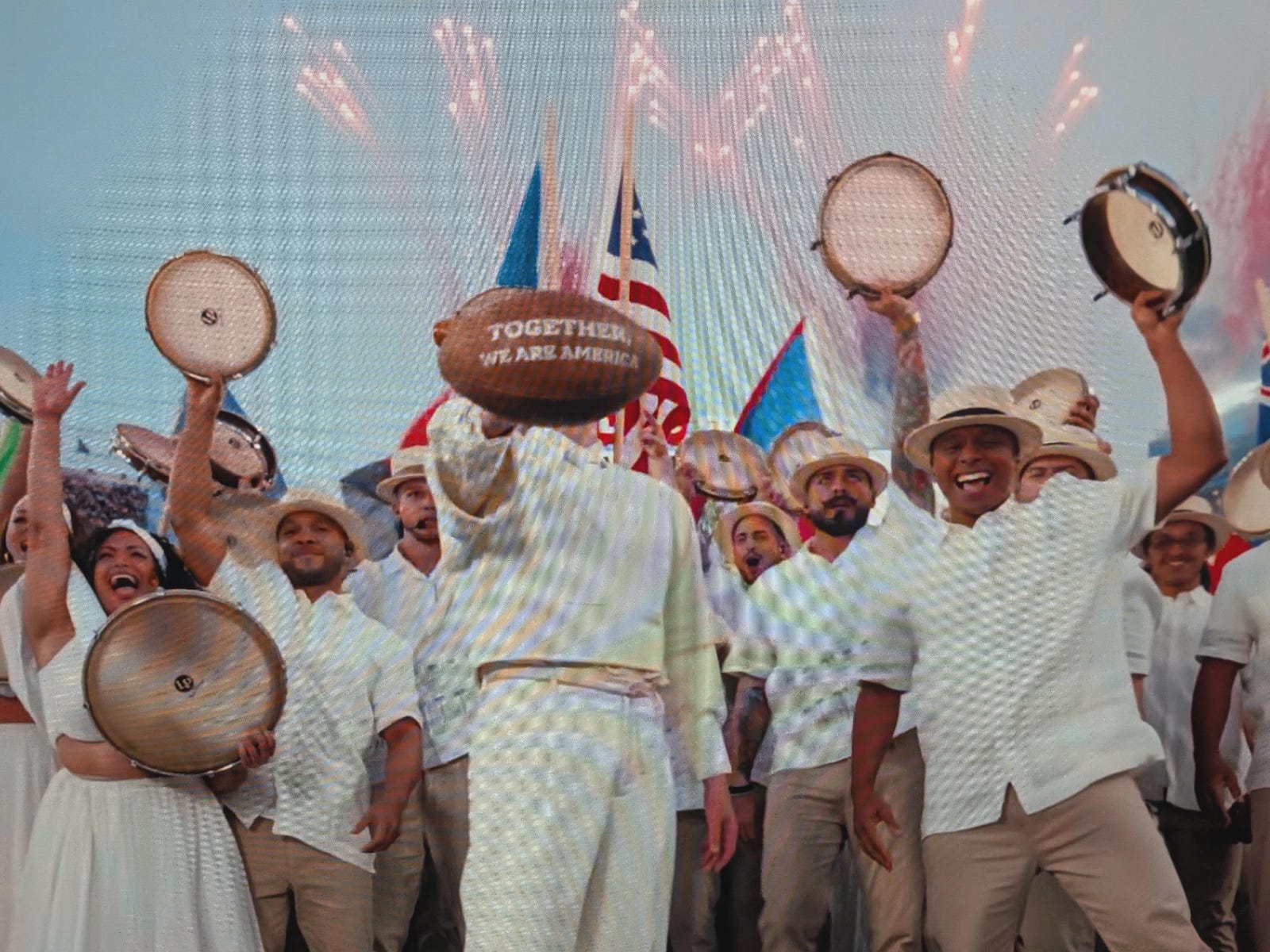
So you can understand why—if Bad Bunny ever orchestrates another environment in which people are needed to play the flora—I am getting my ass on a plane. If there’s any irony to how many of us have been inspired by Bad Bunny’s human bushes, that’s probably because dressing up as a bush or a tree is often seen as a humiliation; the pity prize offered to someone who tried out for the school play and couldn’t land a role with dialogue. But here’s the thing. While there’s plenty of prestige to be won from headlining a show or even being a part of an ensemble, the silent background extras receive a different kind of prize. Basically, they get to live in the orchestrated environment of the show for a few hours. And speaking as a two-time background extra myself, I can confirm that living in an orchestrated environment is a lot of fun.
Since the late 2000s, when The Departed won Best Picture and put Boston on the map for moviemakers, as a veritable hotbed of townie ritual and aggression, a ton of films and TV shows have been shot here. About a decade ago, intrigued by the chance to bump shoulders with visiting celebs, I joined Boston Casting (New England’s premier entertainment agency) by creating a free “hire me!” profile for background extra gigs. Yes, I lied in a few places, such as claiming that I had experience handling swords. And within a couple months of joining the agency, my ship came in. It was a thriller titled “American Odyssey,” about an unlikely trio—a soldier, a lawyer, and an activist—who discover a conspiracy involving corporations funding terrorism. Part of the pilot was being filmed in Boston’s Financial District, against the backdrop of an Occupy Wall Street-inspired protest encampment. They needed a lot of people to play protesters.
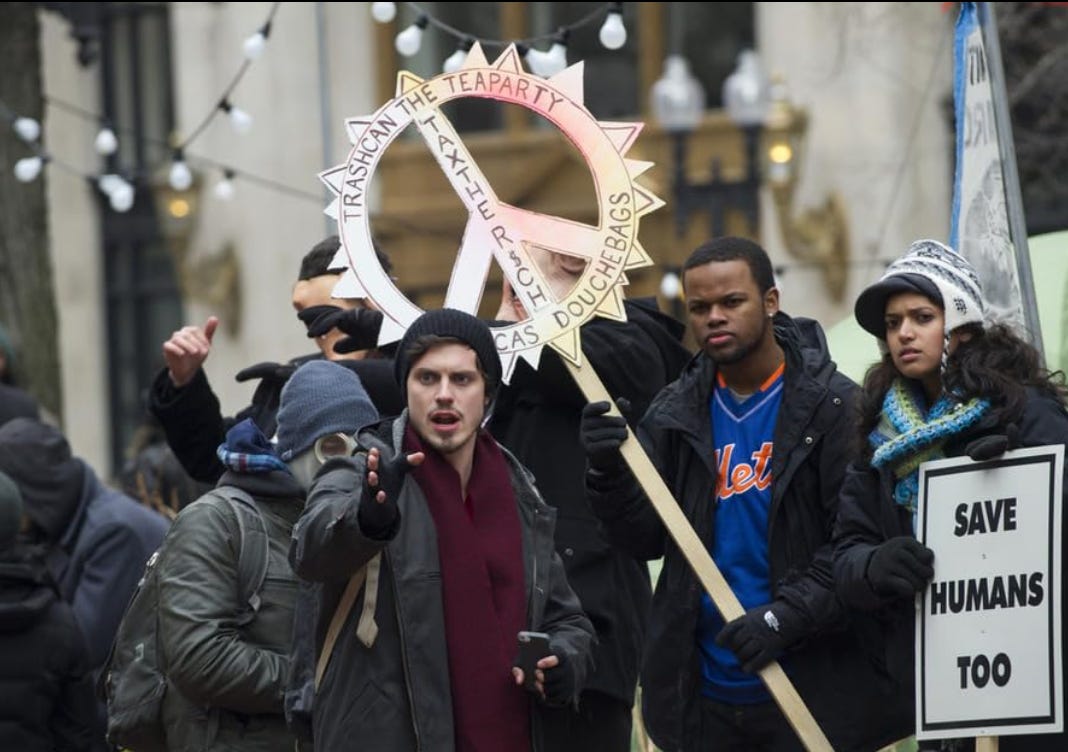
I got the call, along with a couple hundred other New Englanders with varying levels of experience or investment in the entertainment industry. We were booked for two days of shooting, in the middle of winter. Most of us weren’t fitted with costumes ahead of time and thus, we were asked to bring our own wardrobe. “You should look like you haven’t been home for a while!,” the instructional email from Boston Casting began. “Layers are good, things that keep you warm, nothing fashionable. Think ex-hippy, grunge, quirky, funky, artsy, alternative. Nothing bright. Stick to dark, muted colors. Jeans are good. Jeans with holes that we maybe see a thermal underneath is good. Nothing cute. Like you’ve just been outside, knits, hats, sweaters, etc.” Paired with a 5:45am call time, this gig had the trappings of an adventure. When I showed up at Post Office Square for Day One—bundled in a rattty wool coat that had I found in the back of my dad’s closet—I entered another kind of orchestrated environment.
The production team had done their homework. The replicated encampment, large enough to occupy more than half of Post Office Square, had built elements which I recognized from my 2011 visit to the Zuccoti Park encampment that materalized at the height of the Occupy Wall Street protests. There were tents, a library, a kitchen, a medical station, a bicycle-powered charging station for phones and laptops, and lots of drums and prayer flags. From dawn to dusk, the assistant directors shuffled us to various points of the encampment and gave us temporary background parts to play. Near 11am, I was on the frontlines with a throng of protesters shouting and shaking my fist at a bunch of well-dressed corporate lawyers exiting an adjacent building. By 6pm that evening, I was taking part in a big group yoga session in the encampment, doing my best downward dog and sticking my butt in the air just as the director and the camera crew swung by to shoot B-Roll footage that might make it into the pilot.
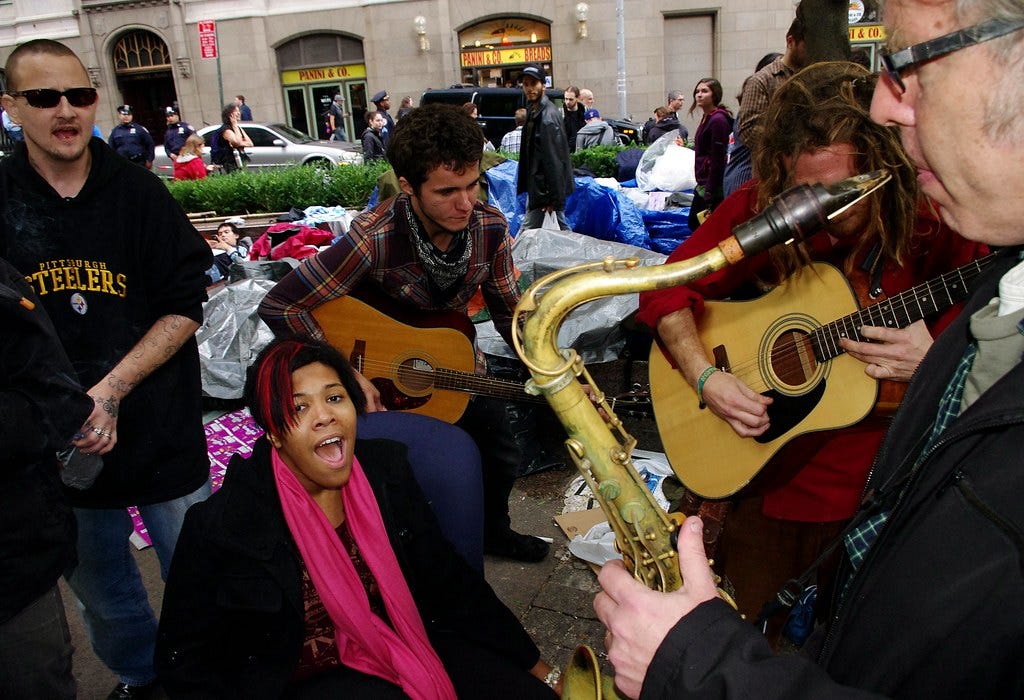
It was one of the most strangely enjoyable experiences that I’ve had: being part of the orchestrated environment of American Odyssey. Essentially, we were immersed in this alternative reality where we had limited agency—someone else was making most of our decisions for us—but where we were all working together to create something interesting. Meanwhile, our basic needs are taken care of. The production crew kept everyone fed and hydrated. A nearby office was procured for the extras, so that we could warm up indoors when the crew was setting up new shots. Of course, we got paid for each 12-hour day of shooting. But the check felt almost secondary to the more rarefied reward of getting to play Make Believe with so many other people, in this built environment with too many details to capture in the course of one scene.
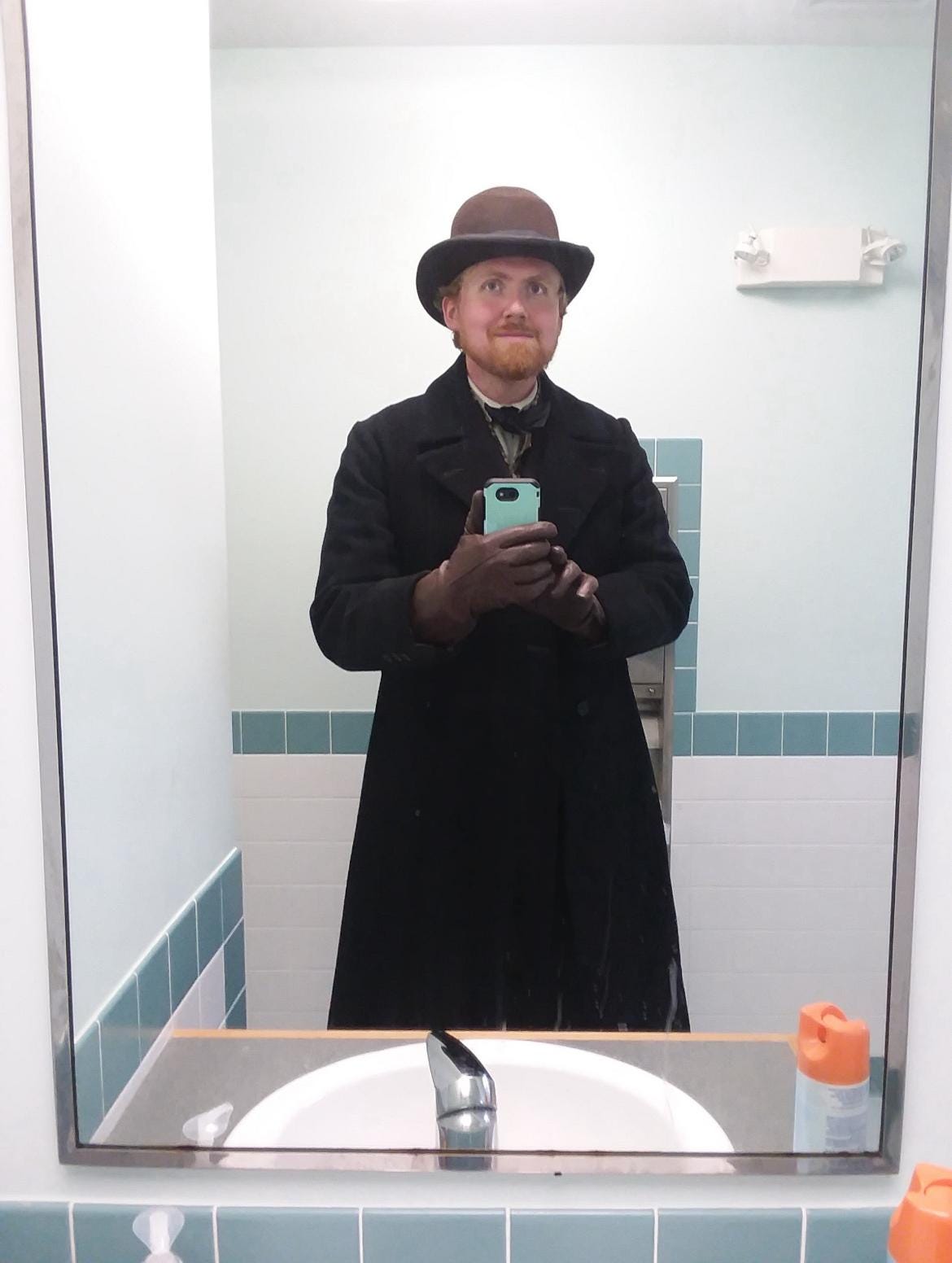
That last part really resonated with me a couple years later, when I scored my second background extra gig for Greta Gerwig’s 2019 adaptation of Little Women. This time, I was an upper middle class Concord gentleman, dressed in a heavy black overcoat with extensions in my beard and a large stack of Christmas presents for my imaginary kids. For the first shot of the day—the March sisters walking down the main street of 19th Century Concord, which had been built from scratch in the nearby town of Harvard, Massachusetts—the assistant director placed me halfway up the wooden staircase on the bank building. I thought about the structural engineering it must have taken to ensure that actors could stand on the staircase, which would be lucky to get a second of coverage in the finished movie. That’s the thing about orchestrated environments, whether they’re assembled for a film, a play, or a concert. They need to be capable of hosting many actions and moments, including some that won’t actually be seen by an audience. I learned this the hard way when one of the assistant directors brought me down from the stairs and instructed me to walk past Saoirse Ronan. Every neuron in my brain was buzzing. She was on my left, the camera was to my right, and I took this as a sign that I had lucked my way into the final cut. But the moment barely made it into the trailer. In the movie itself, I was nowhere to be seen in downtown Concord.
But I would go there again in a heartbeat; just as a lot of us would consider spending four figures just to make it to Bad Bunny’s next orchestrated environment, if he ever decides to build one again. That’s number two on my aspirational list of background extra roles. The top slot belongs to the unlikely event that George Miller is allowed to make one more Mad Max movie. (The most recent sequel, Furiosa, was acclaimed by critics, but its box office gains paled to Fury Road.) If that happens, and if the call for extras makes it to Boston, I will be flying to Australia; driven by the dream of being outfitted with post-apocalytpic warts or tumors, dressed in leather and metal, placed on a moving vehicle in the desert, and given a name like “Splooge Boy” or “The Bone Carpenter.” That’s my hope, when it comes to visiting an orchestrated environment.
And I’d like to know what yours might look, or where it could ideally take you. Clearly, the Bad Bunny halftime show has inspired a lot of us to chew on that question—to envision a temporary world, shaped by the imagination and brought to life en masse, and the prospect of enjoying that world together. Some might see this as a means of coping with the uglier reality that we live in. But if we are ever going to transcend that scorched landscape, we should probably get into the habit of envisioning another one.
What a distinct and beautiful post! I love where your brain went from the BBB (Bad Bunny Bush). Bravo, Splooge Boy