
Please don't use AI to plan your next hike
Sometimes, more friction yields better outdoor experiences


Those of you who’ve read Mind The Moss for a while will know that I’m something of a skeptic, if not a militant, when it comes to the role of generative AI in our lives. It’s not that I’m unwilling to recognize scenarios or applictions in which Large Language Models (LLMs) could eliminate some of the unneccessary friction from daily life. The work of organizing gathered information into something like a spreadsheet is fairly tedious work that an AI program could do in five seconds (though I would strongly prefer to outsource this work to a form of technology that doesn’t require obscene levels of electricity and water, as AI data centers consume.) What concerns me most about generative AI is the way it can remove human deliberation from activities that require inquiry and debate; sanding down the types of friction that are good for us.
Consider the last great hiking trip that you planned for yourself or a group of friends. Maybe you spent some time leafing through guidebooks or trawling online forums or Reddit communities to get ideas for where you should hike, where you should eat, or where to park your carcass at the end of the day. At some point in the process, it was necessary to have a dialogue, internally or with your fellow travelers, about the things that should be avoided. If I had been part of that group, I would have suggested that we eliminate trails with freestyle cliff climbing from the list of possibilities. (But if the cliff had ladder rungs or climbing chains, no problem!) Someone else might pipe up and request a hike with limited rock stairs, due to an old knee injury they suffered in high school while playing varsity soccer. These deliberations can feel like work, but they can also be fun. As the specifics of your voyage come into focus, the anticipation grows. And even if it all goes to hell, you can rest assured that hey, you did your best.
So, you can understand why I’m not exactly thrilled about the just-announced news that AllTrails—one of the most user-friendly resources for hiking ideas, online and in app form—has now joined with Claude and become “the first major trail app to live inside Anthropic’s AI assistant.” (Is it just me, or does the thought of “living inside” an LLM bring to mind the gaping maw of a gargantuan sea monster covered in lice?) It was an announcment that I’ve spent the last two years dreading, after watching the integration of generative AI into search engines, email platforms, social media, and pretty much every other venue where information can be summarized into bulleted points. It was only a matter of time before the labor of planning a hike became new terrain for cognitive offloading. And while I could go on at length about the roots of my strong disdain for this trend, no one has time for that. Instead, I’m going to try explaining, as succinctly as I can, why you should not use AI to plan your next hike.
First, AI will never know your comfort zone—or your friends’—as intimately as you can. As an experiment, I decided to try following AllTrails’ suggestions for how to use Claude to generate hiking ideas. This involved literally copying a pre-prepared question from AllTrails, pasting it into Claude, and making a couple of choice tweaks.
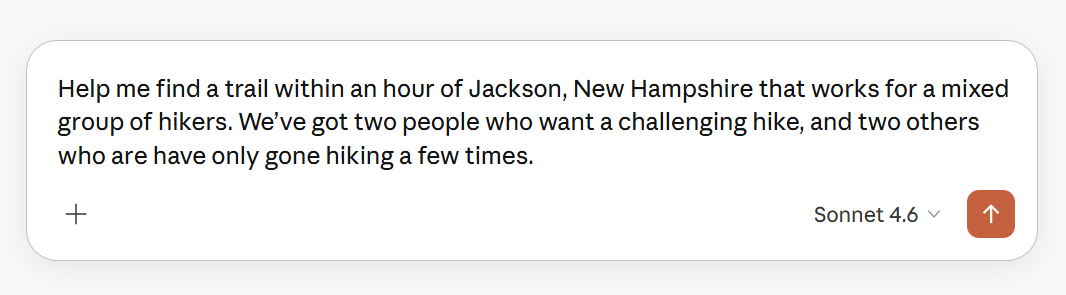
Here’s what Claude—culling from AllTrails—spat back out me, after just a few seconds.
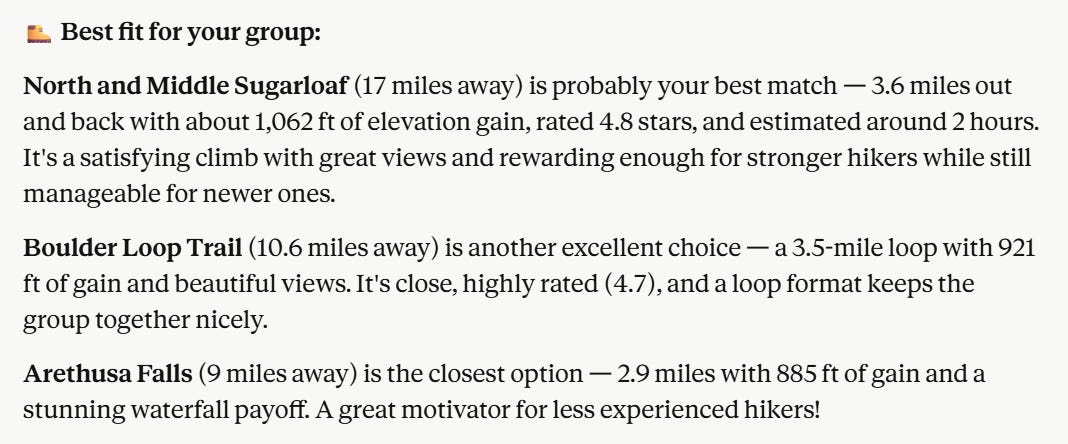
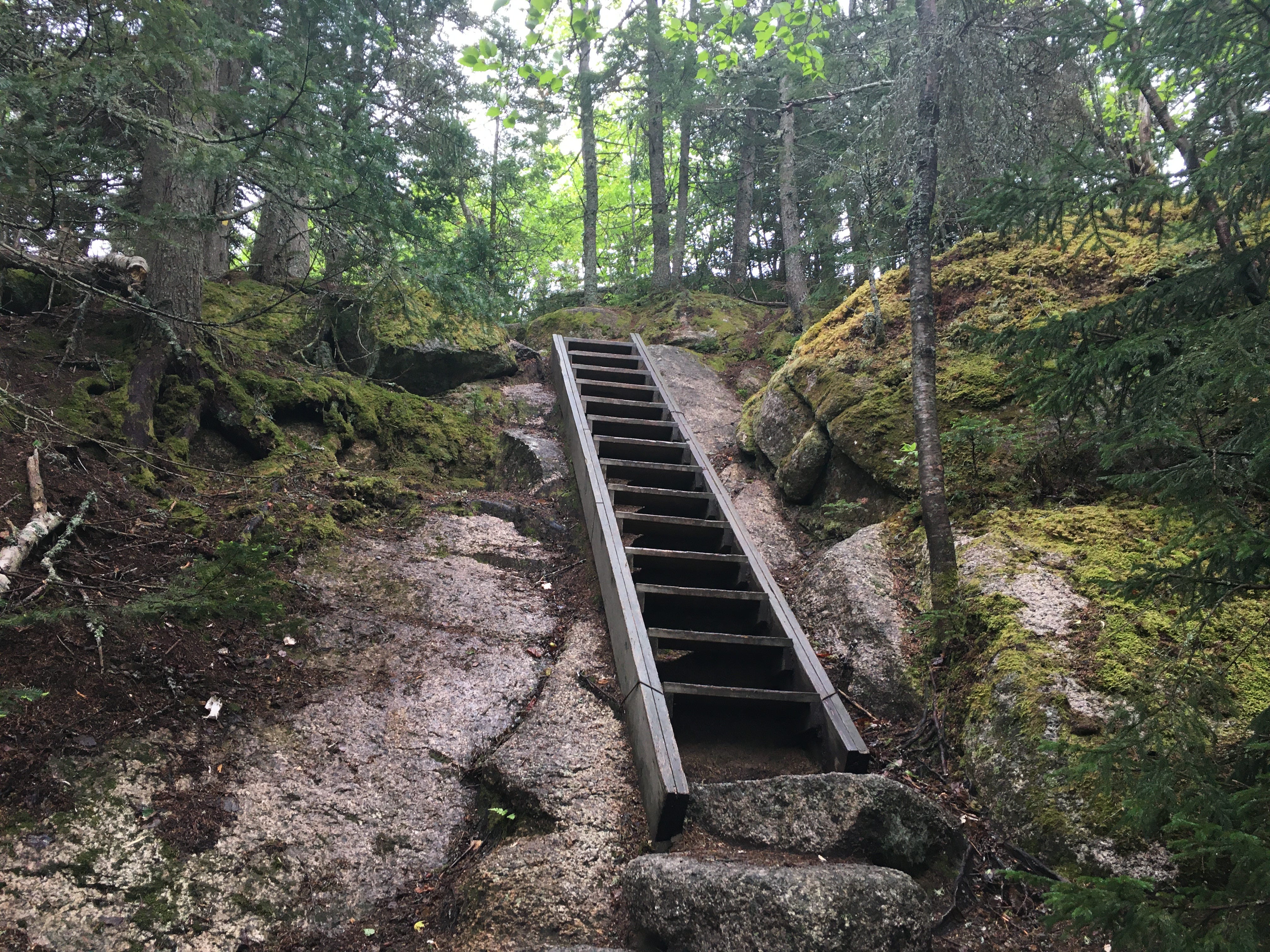
These aren’t bad hikes! But already, I could see potential problems. The trail to North and Middle Sugarloaf, which I wrote about a few years ago, includes a rather tall and steep wooden ladder that could give a lot of experienced hikers pause. This level of elemental specificity about the North and Middle Sugarloaf hike is unlikely to come up in a conversation with Claude if you’re using AI to bypass the labor of talking with your hiking party about comfort levels and things that some folks may wish to avoid on trails. Or opening a guidebook. Or even visiting AllTrails yourself, reading the user reviews of the trail, and looking at crowd-sourced photos, which reveal the tall ladder.
Similarly, the Boulder Loop Trail offers hikers two choices; a steep climb and a gentle descent, or vice-versa. Once again, this is the kind of thing that’s not going to show up in an AI summary of hike ideas unless an LLM knows that you’re curious about it. Why would you be curious? Maybe you’re skittish on steep descents, or perhaps a member of your hiking party struggles with ascending tall rock steps. As is the case with AI chatbots, the results tend to be better when you have something of a back and forth with an LLM, giving it more information and sharpening the answers. But this begs a question; Why not just have that dialogue with your real hiking buddies?
I guess one reason why somebody—not you—might choose to dodge such dialogue by using Claude or ChatGPT to plan a hike is because negotiating a trip plan among friends can be awkward. Expressing the limits of your comfort zone requires being vulnerable, and choosing how to respond to such expressed boundaries is a delicate step to take. Conceiving of something together is inherently going to involve some amount of friction. But there’s a tremendous satisfaction to be enjoyed from dealing with that friction together, and coming out with something that you’re excited about. Several years back, when I huddled with my friends Natalie and Adam to plan a 4,000 footer hike, I was only a year or so past an awful back injury that had severely limited my ability to hike uphill. When they suggested the iconic Franconia Ridge Loop in the White Mountains, I had to explain that I wasn’t up for this level of elevation gain just yet. They took it well, absorbing my limitation, and we ended up setting the controls for Mount Moosilauke instead; a less relentless climb, but still a big old rock monster that left us scenically dazzled and sated, when we finished the hike around sundown.
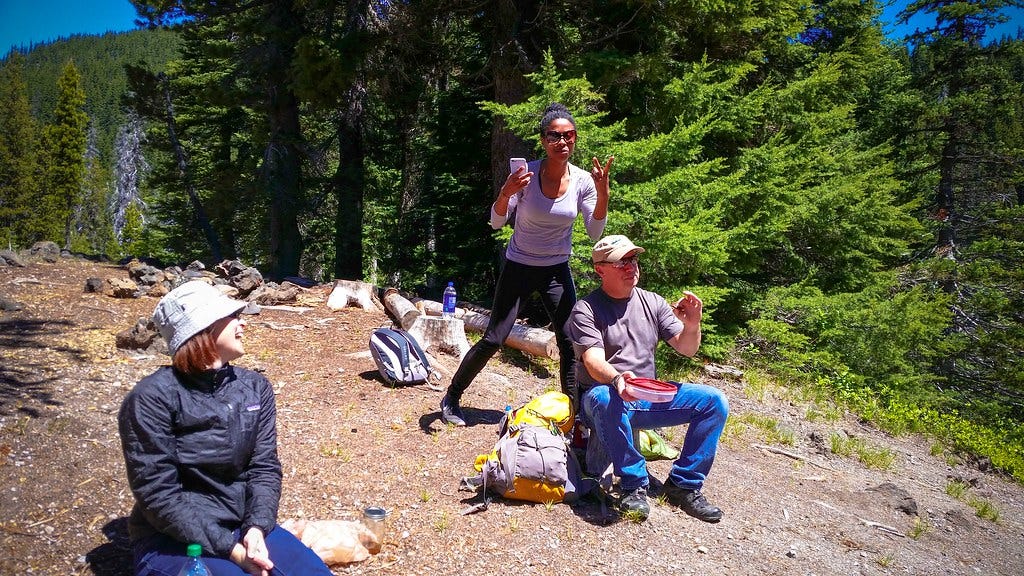
That’s the other thing that makes me wince at the thought of people using AI to plan their next hikes. Finding ideas for hikes can be a rewarding social experience, and using LLMs can deprive you of making connections to hiking communities. Take the growth of groups like Outdoor Afro, the Venture Out Project, and Unlikely Hikers; all of which are built on the goal of making it easier for people who’ve been excluded from mainstream outdoor culture to get onto trails, with the guidance of folks from their communities. Even if you’re not planning on attending an upcoming joint hike with a local group, connecting with that group in-person or online can still open the door to hikes that you might want to pursue in the future, solo or with accomplices.
Even forum-based websites like Reddit can be a fruitful place for getting great intel for where to go hiking, and connecting with other users over a shared affinity for a trail, or fierce disdain for it. One of my favorite hobbies, as a member of the WMNF (White Mountain National Forest) subreddit, is to steer people away from skin your shins mountain hikes toward trails that sound more fitting for their group. Often, I’ll see posts like, “My 7-year old son and I are going to take our first White Mountain hike this summer. He’s a bit nervous with heights and I’m wondering which trail on the Tuckerman Ravine headwall offers the least exposure on the way up and down.” This is when I slide in and suggest the more serene pleasures of Zealand Falls and its adjacent beaver bogs, or—if a climb of any sort is necessary—a jaunt up to Mount Willard for a banger view of Crawford Notch that punches way above the relatively short and gentle trail to the summit. If I’ve offered some solid ideas, other Reddit users will chime in and affirm the suggestions. Often, they’ll add other good ones. And I’ve been on the opposite side of this: venturing into some hiking forum with a rough grasp of what I’m looking for, and re-emerging enlightened and empowered.
Hiking is often misunderstood as a sport of individualism. So it makes perfect sense, in a really depressing way, that tech companies with products that can super-charge social isolation are now getting on the action of the hiking renaissance. And as more people start turning to these products for tasks and decisions that are better hashed out with real people or the resources they’ve created—books, blogs, forum posts, or even GoPro videos posted on YouTube—the consequences will come in the form of more hikers getting into trouble outdoors, more search-and-rescue calls, and more missed opportunities to connect with other people who are interested in hiking. The good news is that resisting this cognitive offloading is extremely simple. If you don’t like the sound of using AI to plan your next hike, don’t use AI to plan your next hike.
I promise, you will be happier for it. And I don’t often make big promises in public. But that’s small potatoes next to what Sam Altman and Dario Amodei have been hawking.
Great article, as always!
True not just for hike planning.