
Stealing Third Space
We need more places for hanging out

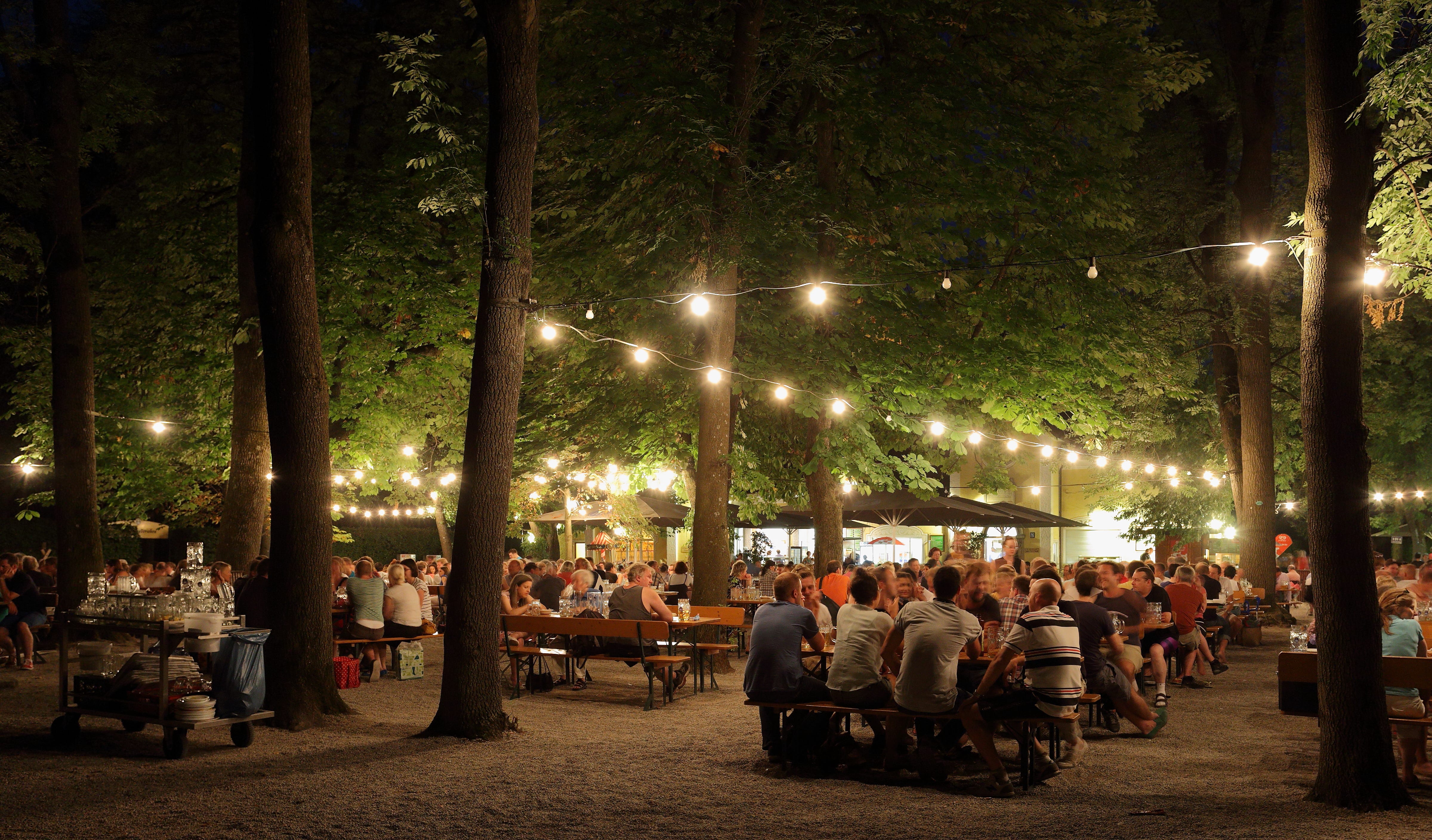
Last summer, I got to spend some time chilling and catching up with an old friend from high school who was in the Greater Boston Area to recover from surgery and begin physical therapy. I would pick her up, we would drive to a coffee shop with shaded outdoor seating, and for the better part of the afternoon, we would talk, recaffeinate, and tinker away at work on our respective laptops. While this hadn’t exactly been part of her plan, my friend was wise to schedule the surgery for early June. Because if she had returned from the hospital today, hanging out together outside of the house where she was moving around on crutches would have been considerably more challenging. Not because of snow or ice, but because of space.
Or—more specifically—because we could use more Third Spaces; venues that are not home (the first space) or a workplace (the second space) where we can be with other people, for free or next to free. This may sound wonky or academic at first, but most of us have cultivated a few third spaces in our lives. That dive bar that still offers $5 PBRs and always puts on The Cure’s Disintegration after 9pm? Third Space. The loop path around the closest pond where you meet up with a friend to stroll, run, and/or people watch? Third Space. A plaza where people are shooting the breeze, tucking into sandwiches, and shooting “fuck around and find out” glares at pigeons? Third Space. These are a few examples of the Third Spaces one can find in America these days. But…did you notice the key difference about that first example? The dive bar?
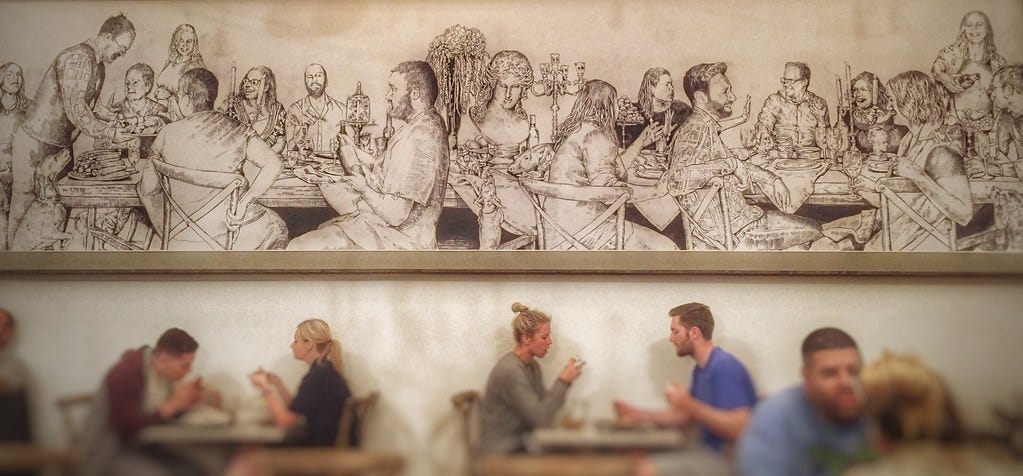
A bar with cheap drinks and a culture of hanging out is a perfect example of an indoor Third Space. And this is where most American cities and towns really struggle to keep up with other parts of the world. A public park or green space in which you can work out, picnic, or meditate—with friends, or in the company of strangers—is a perfectly fine Third Space when being outside is safe and reasonably comfortable. But when it’s pouring rain, cold enough to make tree trunks buckle, or stifling hot, the open air kind of Third Space is effectively closed. You’re left seeking similar social refuge in a climate controlled environment that doesn’t come with a high price tag for just being there. I have had a pretty difficult time finding these in Boston and in other parts of the U.S.
I happen to live in a neighborhood where indoor Third Spaces are in short supply, and nothing magnified this like those scorching and steaming heat waves that the Greater Boston Area suffered this past July and August. Like many others, I live in an old triple-decker that was not built to withstand such heat, and there’s only so much one can do with window air conditioners. On days when I craved the presence of other humans, I would trudge through the blaze to the small handful of coffee shops and bars located within one mile of the apartment, only to find each central air-equipped space packed with others who had the same idea and got there earlier. There were no vacant seats, and the situation at the local library—not exactly a good place for talking animatedly with a friend—was no better. To hang out with other people outside of the apartment, in relative comfort, I had to take the train deeper into the city and expand my search.
All of this has been on my mind for the last few days. Not just because it’s colder and tougher to spend prolonged time outside, but because I just learned that one of the largest indoor Third Spaces in Boston—the Time Out Market food hall located near Fenway Park—is closing its doors at the end of the month. This was a crushing bit of news to absorb, because for all its shortcomings, this huge cafeteria-esque joint was one of the only reliable indoor venues in Boston for meeting up with friends without having to spend more than a couple bucks each on food or drinks. You could order an entire barbecue platter or a trilogy of overpriced cocktails if so inclined, but getting a single egg roll or even a small coffee was also acceptable. Hell, I sometimes met up at the marketplace with folks and didn’t a spend a dime. You could do that too! Because at the end of the day, Time Out Market was as much a gathering space as a business.
Losing Third Spaces like this, or suffering from a growing shortage of them, is what I would call a civic emergency. The “epidemic of loneliness” that former U.S. Surgeon General Vivek Murthy declared back in 2023 has gotten worse for millions of us, as we watch the world burn through our phone screens and in some cases, on our streets. And while growing recognition of this epidemic has inspired more of us to find ways of reconnecting with friends and community—whether it’s going on a group date or organizing mutual aid projects like getting hot meals to neighbors in need—we also need places outside of the home or workplace where these efforts can be talked out, planned, and potentially hosted. And the big obstacle that we keep runnning into in cities like Boston and countless towns is that it costs money to operate Third Spaces.
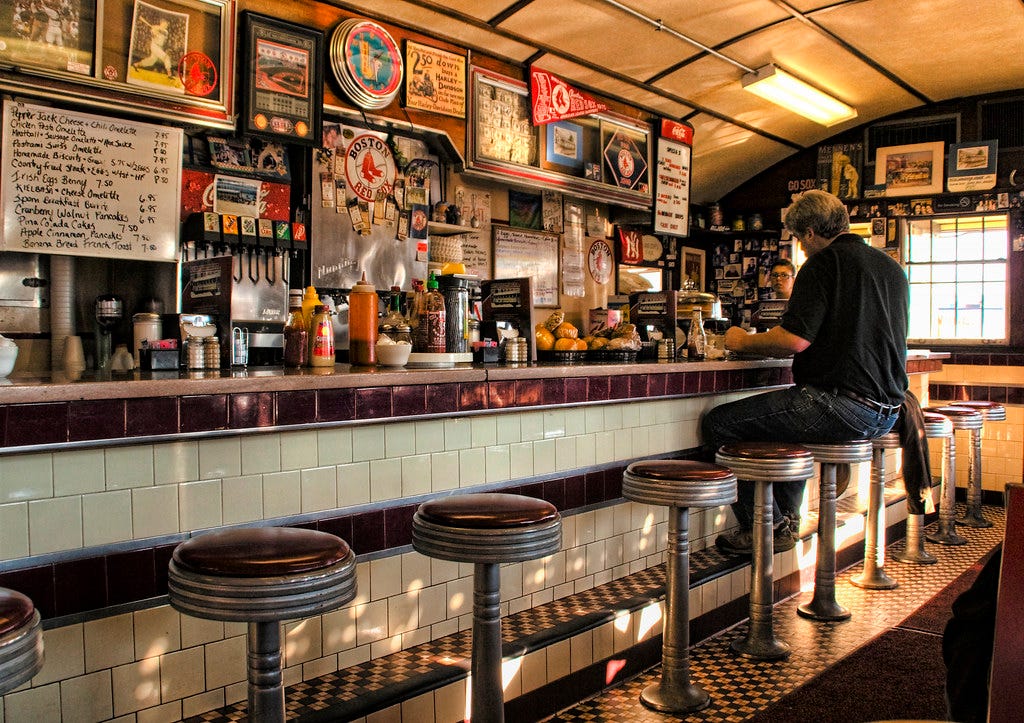
Consider the small businesses that we’ve long asked to perform the work of providing Third Spaces—coffee shops, bars, and restaurants where you can get a bite to eat for $10 or less. Some establishments do have business plans that account for customers hanging out and sipping their beverages at a glacial pace. But in the current economic climate, with food and beverage providers struggling to contend with rising expenses, the pressure to get patrons in and out the door faster is growing. Not long ago, I met up with a colleague for lunch at a ramen place in Cambridge, and we got so involved in conversation between slurps that the host walked over and bluntly told us that we needed to hurry up and finish our bowls, so they could seat the next party. Sure, it was rude, but it was also a reminder that asking small businesses to be Third Spaces has a ceiling. Today, with commercial rents and operating costs soaring, we may be hitting it.
So what could an intervention look like?
One of my favorite cities in the world, Berlin, has been running into the same problem when it comes to nightclubs. The legendary and sometimes notorious techno clubs of Berlin that began in derelict buildings after the wall came down were vital to the city’s rebuilding and rebranding as a hot travel destination. And when tourism escalated to gentrification and rising real estate costs, the owners of these nightlife venues saw the writing on the wall and began lobbying the government to reclassify clubs as “cultural institutions”—the same status bestowed on opera houses and museums, which carries tax breaks and more supports from the state. Their pitch was approved by the federal government in 2021, providing Berlin’s clubs some relief from the pressures of having to make more and more money to continue operating. And I find this rather inspiring.
If Germany’s parliament was able to recognize the cultural and economic logic for supporting clubs where you might find yourself dancing or experiencing your first threesome, maybe American cities and states can look at Third Spaces in the same way! Reliable places to gather, outdoors and indoors, aren’t just good for the soul; they’re good for business as well, because they encourage folks to venture out more often. Suppose I invited you to go ice skating at the Frog Pond on Boston Common on a blustery afternoon in February. Ehh, do I really want to be out in the cold for so long? you might wonder. Would we have to warm up in the vestibule of a Dunks or a Burger King near the park? But what if I told you that once we had our fill of skating, we could take shelter beside the ice in a toasty chalet with a crackling fire, couches, and optional hot chocolate and croissants that we could purchase, if we felt like it?
That fantasy is a reality in Montreal’s Quartier des Spectacles, where the onsite ice skating rink—the Esplanade Tranquille—is paired with a cozy lounge where you can gaze down at the skaters and recover from the arctic winds. For free! You don’t have to buy any of the refreshments sold there, or pay for admission. How is this possible? Because the Quartier des Spectacles is a planned cultural district with direct support and oversight from the City of Montreal, and several of the offerings found within are basically nonprofit entities that can operate at a loss; in a way that a normal brick and mortar business could not. And the Esplanade Tranquille is just one of those entities.
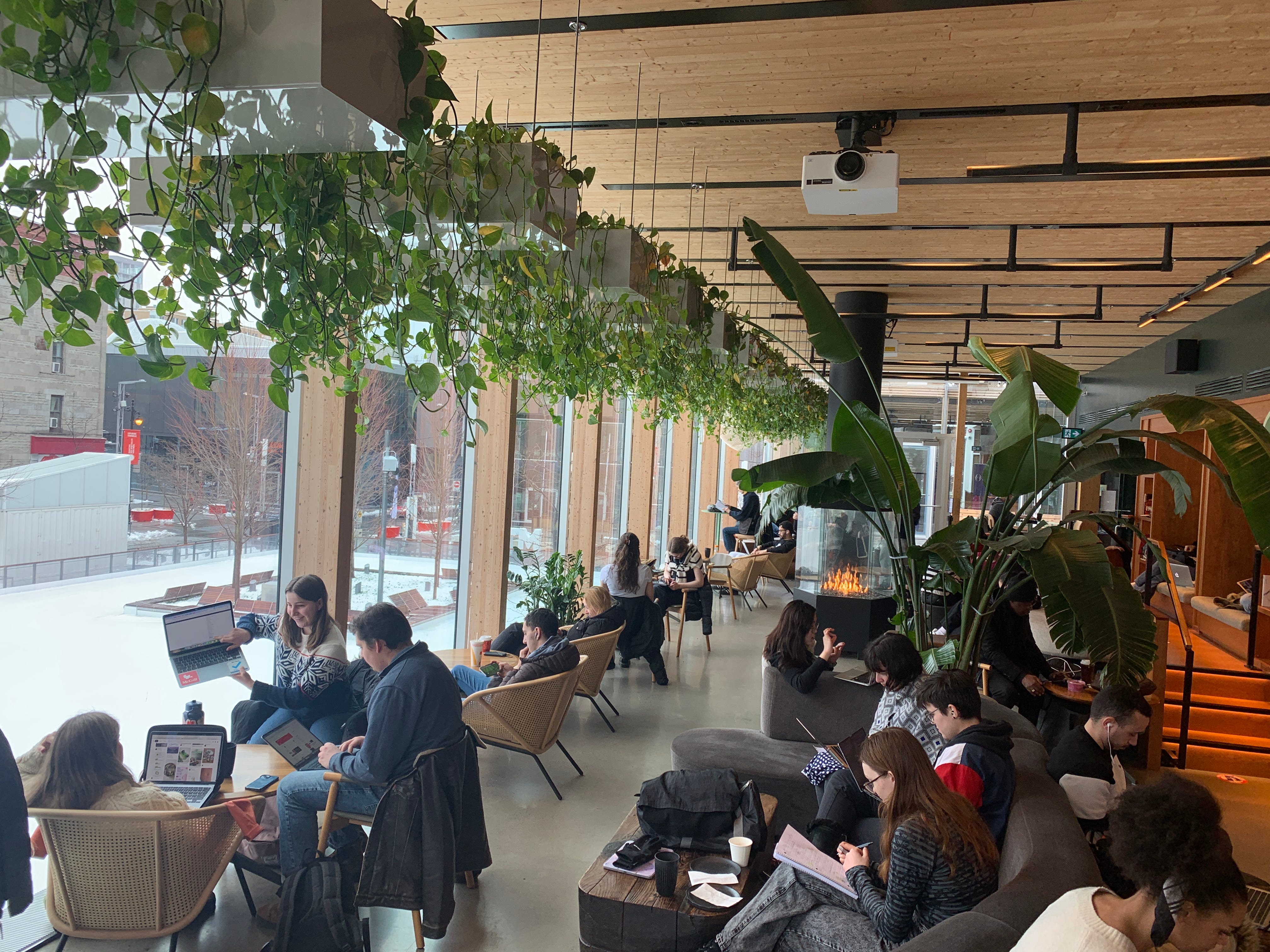
Protecting and creating more Third Spaces is a civic investment that we could choose to undertake at any point. As usual, the hurdle we face in America is mental; the idea that government can’t compete with the private sector, or work in concert with it, to provide essential goods. It’s a stubborn affliction, lingering in too many of our minds even as cost of health insurance, housing, and childcare pushes millions to the edge of solvency. Unfortunately, it’s going to take more time—and probably more suffering or disruption—for Americans to get past this cognitive roadblock, giving policymakers the confidence to support Third Space investment. So…what can we do in the interim?
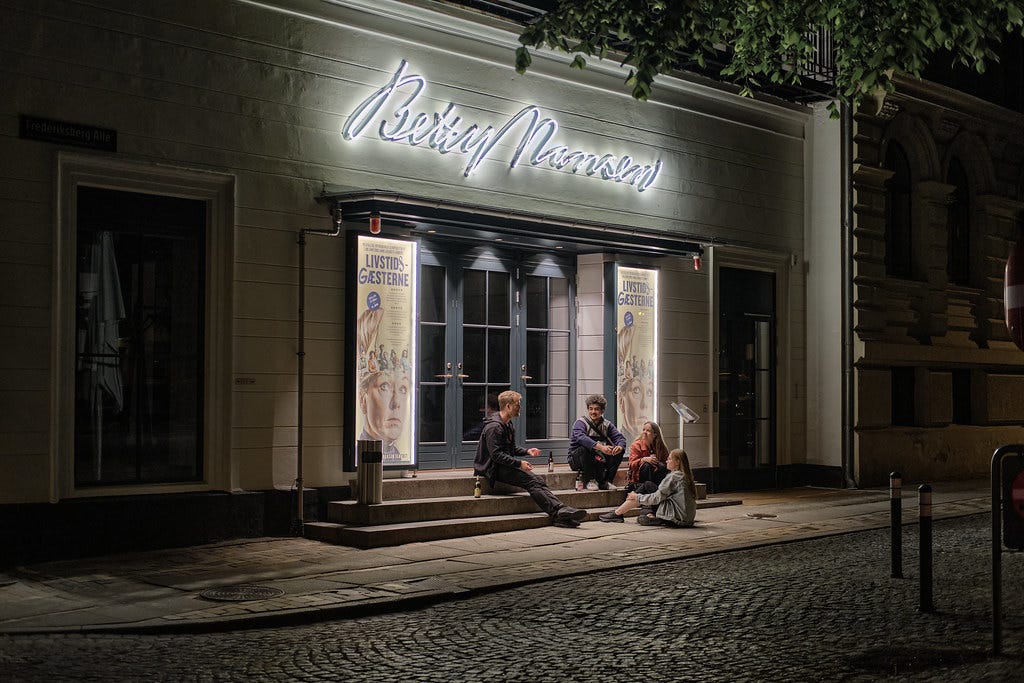
As my friend reminded me last summer, there’s always the option of “stealing” a Third Space, whenever possible. She’s a resident of Brooklyn for most of the year (her family lives near Boston) and one night, as we pushed burritos into our faces in a streetside dining area, she spoke of something wonderful that I’ve seen on trips to New York; the way that New Yorkers will utilize a stoop, the edge of some bodega, or the interior of a hotel lobby for hanging out and catching up. In a city that’s as dense and expensive as NYC, you have to be bolder about occupying available space wherever you’re able. Yes, you might be asked to move along at some point, if you’re stealing a third space inside or around a business. But you and a friend may just manage to squeeze a solid half hour of hangout time from the place—or even longer! These days, that’s a victory.
I’m planning to do this tonight, actually. Since the late 2010s, I’ve beein going out to movies in Boston with my friend Steve, and our salvation has been the AMC “A-List” subscription program, which allows you to catch four weekly movies at AMC Theaters for less than $30 per month. And while this varies theater to theater, we’ve found that most of them will let you inside the ticketholder area long before your showtime. For us, this means having more time to catch up, trade life updates, and enjoy being there together, before we dive into a new cinematic world. This evening, that world will be 28 Years Later: The Bone Temple, in which Ralph Fiennes plays a kindly doctor dealing with a zombie pandemic by using bones to build a monument to the dead…while Jack O’Connnell deals with it by running a Satanic cult—in which dressing like Jimmy Savile is a requirement—and terrorizing survivors scattered across the British mainland. This might sound unlikely as a foundation for continuing our friendship and appreciating the simple beauty of being out there in the world together, engaged and inquisitive.
But for the moment, it’s what we have to work with.
Great piece of writing. I've spent a lot of time living in different cities and I actively searched for 3rd spaces. One of my favorites is the Citizen M hotel on Bowery in NYC. The sunken lobby is a great place to hang out.
Miles, I am sending you, a bit late, best wishes for a Happy and healthy and benevolent new year - 2026. And to thank you for urging us all culturally forward, public hang-out spaces being only one of many, many elements we need more of. Too, too sad to learn that the former Sears Roebuck meeting hall will be closing soon. It has been one of my gathering spaces over recent years. We elders are in a special category of needing public/private gatherings and a comfortable space in which to assemble and laugh loud and long. I would readily appoint you as metropolitan assembly coordinator, along with walking trail developer and navigator. In Harvard Square, the Smith building can sometimes serve that purpose. I do appreciate your vision and energy in the work you do - bringing an urban civilization back to cities