


By now, a frosted gray reality is setting in for thousands of us. We’re now in the jaws of winter. We won’t be getting out for quite some time. So we may as well make the most of this predictable cycle of bleakness and find ways to enliven the senses until the days grow longer and brighter again. And if the idea of slipping on microspikes and trudging into some remote and snowy forest just doesn’t get your gears whirring, what then? Where can you get your adrenaline bubbling with more limited exposure?
Once again, an answer lies hidden in Rhode Island. Very few states punch above their weight like Little Rhody, which is why I will always have a soft spot for this state; in the same way that Star Wars fans love Yoda, with his diminutive form, big ears, and bigger (and lethal) lightsaber skills. When Rhode Island isn’t upstaging the other five states in New England with its restaurants, art festivals, and local legends—like a burning ghost ship called The Countess Augusta, sometimes observed off Block Island in the winter—the Ocean State boasts some of the most scenically romantic coastal environments in the northeast. And as it turns out, one particular piece of the coastline near the state’s southwestern tip is home to what might just be the hardest hike in all of Rhode Island!
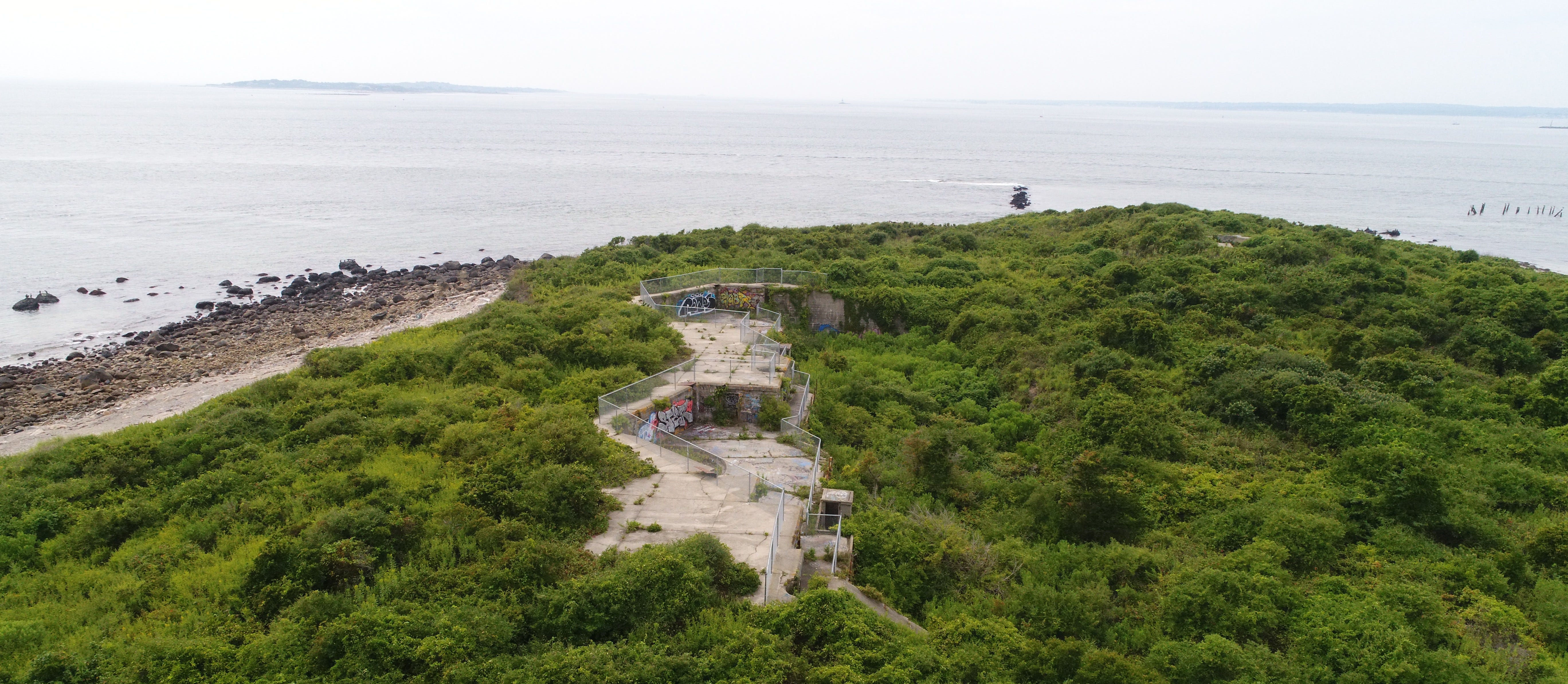
Whenever the Westerly-based neighborhood of Watch Hill comes up, the immediate association for most people is Taylor Swift, whose $17 million mansion looms over one of the beaches here. Watch Hill was already a shit-hot coastal destination among the gilded class before Swift breezed into town back in 2013. Local beachside resorts such as the Ocean House are reliably filled with guests and diners each summer. But what’s lesser known is the scale of Watch Hill’s beach, and what it leads to. A long and sandy spit (a pencil-shaped peninsula created by tidal transportation of sediment) juts out from the beach into Long Island Sound. And at the far end of this spit is a place called Napatree Point. In the late 19th Century, Napatree Point was transformed into a small naval fortress, as military strategists considered the vulnerabilty of the sound and its infrastructure during wartime scenarios. This coastal artillery installation was dubbed Fort Mansfield and activated in 1901. But a few years later, a war game simulation on the water revealed an artillery blind spot from which a ship could approach the fort without getting in range of the guns. And just like that, Fort Mansfield was scrapped.
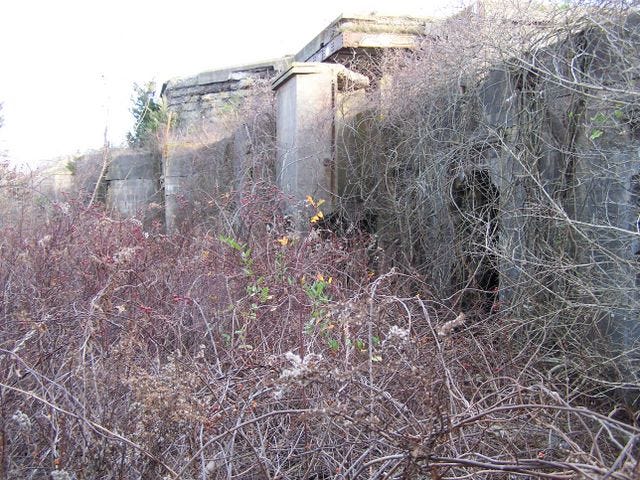
You would think that the architects of the fort would have employed somebody whose only job was to check artillery angles—just like you’d expect a transit authority to have one staffer whose sole responsibility is taking measurements of all the train tracks, just to make sure that any newly-ordered trains will fit the tracks. (Apparently, in France and here in Greater Boston, this has not been the case.) But in any event, the closure of Fort Mansfield saw the naval installation reduced to a crumbling ruin, which is now tagged with graffiti and something of an under-the-radar destination for Little Rhody explorers. Getting there by foot appears fairly simple at a glance. You set off from the sandy end of Fort Road, steps away from Watch Hill’s historic Flying Horse Carousel, you hike the length of the spit to arrive at the craggy foundation of the lost fort, and then you walk back toward town on the opposite edge of the spit. Pretty easy, right?
Well, there’s a rather sneaky and consequential twist.

When an outdoor-adjacent destination is as storied and bustling as Watch Hill, finding a place to park your vehicle is going to be extra challenging. (There’s no public transit connection from Watch Hill to a nearby city or town, so driving is going to be the only option for most visitors.) While there *is* non-resident parking available by the beach, these spaces come with a strictly-enforced 2 hour limit. And the round-trip voyage to Napatree Point and back is just over 3 miles. Now, let’s do the math. In order to avoid a gilded class-level parking ticket, you must maintain an average hiking speed of 1.5 miles-per-hour for the hike. That may not sound like much, given that most of us walk at a speed of roughly 3 mph. But here’s the thing. Hiking out to Napatree Point means traversing sandy ground that constantly shifts beneath your feet—tiring your lower limb muscles faster and potentially cutting your normal pace in half. And we haven’t even touched on the question of how much time you’d like to spend poking around the point and the fort ruins themselves. There won’t be much time for lingering there.
This narrow window is what makes a hike to Napatree Point uniquely challenging and risky. It’s a more controlled exercise in flirting with danger that won’t potentially lead to an emergency room, as a high altitude winter hike in the White Mountains can. But a $50 parking ticket can still hurt, and if you attempt the Napatree Point Challenge in the summer high season, you’re pretty much guaranteed to pay if you’re more than a couple of minutes late in returning to your vehicle. Which means….we have officially entered the season in which hiking to Napatree Point carries the lowest level of risk! Winter in Rhode Island is quiet. The golden hordes aren’t chasing fried calamari and chartered yacht rides across the coastline. I’d imagine that the allure of Taylor Swift’s mansion and her occasional presence in Watch Hill attracts some evergreen tourists throughout the year. But statistically speaking, there’s no better time for attempting the hike to Napatree Point, if you’d like to dodge the fiscal danger and enjoy the fort.

My first and only foray to Fort Mansfield happened in early spring of 2022. I was on my way to Philly to see some friends, and I decided to take advantage of the balmy conditions and the modest crowds by making a sandy pit stop in Watch Hill. When I began trekking across the spit, I was expecting the squishy terrain and aching calves, and I managed to keep moving at a steady clip. But any sense of time management went out the window as soon as I arrived at the fort ruins. The slabs, festooned with spray paint, pratically begged to be climbed. The rusted chainlink fences around the fort’s bowels also sparked the impulse to climb. And when I gazed out toward the North Atlantic, I couldn’t help but wonder how it would feel to be the artillery gunner at Fort Mansfield—had the design flaw not been discovered—staring at an incoming enemy ship and realizing, in flushed panic, that it was approaching at an angle that the guns wouldn’t cover. In other words, Long Island Sound is about to be taken, because some guy at an engineering firm messed up or skipped a math equation. And you get to watch it happen. Do you take the rap…or jump the next boat for Canada?
I got so caught up in this nightmare scenario, chuckling to myself, that I burned too many minutes at the fort ruins! My passage back to the Fort Road in Watch Hill was sweaty and hasty—the kind of walk that ultimately sends you to a physical therapist’s office for an overuse injury. Somehow I managed to avoid pushing a tendon over the edge, and even more miraculously, there was no parking ticket waiting for me on the windshield of my car when I completed the hike, 2 hours and 20 after embarking on it. Stupid luck. The same unearned good fortune that makes it possible for you to cross a rotting wooden bridge over a creek, seconds before it collapses. Or to descend a long, steep scree slope without a single stone loosening beneath your boots. Successfully avoiding a Watch Hill parking ticket left me feeling like I had just gained money; just as surviving a dangerous backcountry hike can feel like winning another year of life.

I’m not sure why we do this to ourselves—dancing with danger, and in the case of the Napatree Point challenge, seeking danger in a seemingly benign place. As a naturally anxious person, I’m not drawn to ruination. But occasionally, it’s nice to be reminded that things *can* work out, in ways we can’t foresee; through a mix of effort and luck. Especially when it feels like the world is on fire and there’s no end in sight. If nothing else, hikes such as the Napatree Point challenge that require walking through the fire, demonstrate that everything ends at some point. And sometimes, it’s a good ending.
Napatree Point and Fort Mansfield
Hike distance: 3.1 miles out-and-back
Elevation gain: 32 feet
CLICK HERE for a trail map
How cool! I looked everything up on a map while I read your article.