
The minister of silly walks
Why Alton Weagle's backwards hike up Mount Washington still inspires

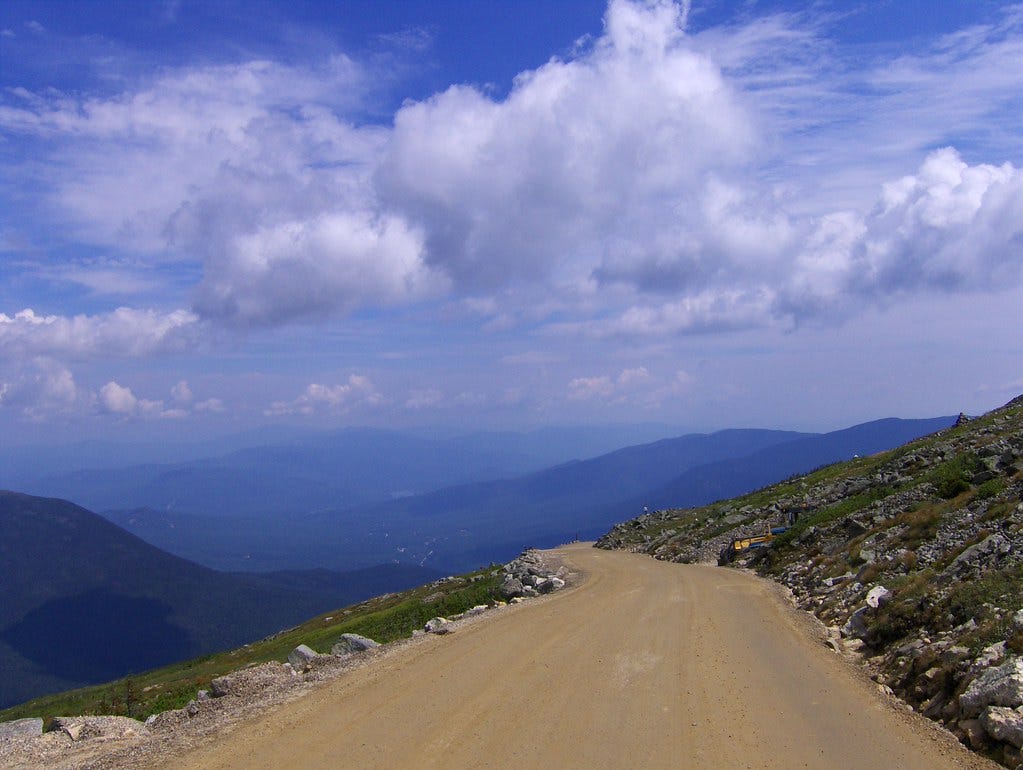
Whenever the phrase “follow your own path” is written or uttered, the context tends to be self-improvement—say, starting a small business or pursuing a degree in post-war film criticism in the U.S.S.R. But sometimes, following your own path can be a lot more impusive and unhinged. Ages back, when I was four years old and meandering around the house on a plastic Fisher-Price tricycle, I decided to “follow my own” path down the stairs from the second floor to the first floor. (Kudos to my parents for not removing the carpeting on those stairs.) And during the 1950s, a man in the Mount Washington Valley of New Hampshire decided to follow his own path up the road to New England’s highest mountaintop, but with a twist. He walked the road backwards.
By all accounts, Alton Weagle was a regular guy—inconspicuously blending into the North Country for most of the year. But during the Truman-Eisenhower era, something inside Weagle began kicking and stirring to life. His backwards ascent of the Mount Washington Auto Road was the first of several experimental walks that defied both convention and reason. He also climbed the auto road blindfolded, and then, he did the climb while pushing a wheelbarrow full of sugar to the summit. And to this day, nobody really knows why Weagle undertook these peculiar walks. The journalist Dan Szczesny came closer than others with his 2018 book The White Mountain, in which Weagle appears as a figure of Mount Washington lore and culture. But still, being able to grasp the “why” behind ventures like Weagle’s may be impossible from a distance.
Instead, the key could be following in his irreverent footsteps, with a walk of your own.
Last week, while reporting a story for Mountain Gazette in Northern Vermont with my friend Dan Brown—a great photographer with a penchant for finding story threads to investigate—we learned about an event on the Mount Washington Auto Road that just took place; an event that we’ve already marked on our calendars for next spring. Alton Weagle Day, which will occur on Saturday May 22 in 2027, is an invitation to invent your own “first ascent” on the Mount Washington Auto Road. In other words, you come up with a method of climbing the auto road that would have left Weagle smiling, you show up at the bottom of the auto road with all the other first ascenders, and then, you make history. A 2013 NHPR feature by Sean Hurley shed light on a few of the first ascents that took place on that Alton Weagle Day. One man did the climb on construction stilts outfitted with 15-foot flag poles, while also wearing a top hat. A group of middle school students climbed the road while dressed up as chocolate chip cookies. They also kicked a soccer ball around during their shared first ascent. But my favorite is Otok Ben-Hvar, who squeezed into five inner tubes and rolled up the road!
The list of Weagle-esque first ascents on the auto road grows more eclectic each year, from climbers dressed as Star Wars stormtroopers to others who used pogo sticks or camels to make it to the top. (I am desperately searching for photos or footage of the latter.) And despite knowing nothing about Alton Weagle Day until 48 hours ago, I’m already in love with this Granite State soiree. Not just because of the batshit creativity it encourages, or the camraderie it must inspire between first ascenders, but because embracing and celebrating the intentional ambiguity of walks like Weagle’s is starting to feel transgressive; at a time when more people seem increasingly uncomfortable with pleasure for the sake of the pleasure, and with life’s many unknowable mysteries.
Maybe, like me, you’ve seen this reflected in the rise of practical articles and features in venues that used to be more devoted to life’s wonders. In the National Geographic “Health” vertical, it’s no longer enough to marvel at the intricacies and unanswered questions about the human body. Now, we’re encouraged to try out biohacks from longevity scientists so that we can stave off death a little longer. Or to organize our homes or offices for improved mood and reduced anxiety. Useful information? Sure, but seeing more and more of this life-optimizing content in NatGeo feels kind of like stepping into an ice cream shop and being offered cookies-and-cream with activated charcoal for gut health. And I’m not making that up. It’s the flavor of the month at the neighborhood ice cream counter where I live. I don’t know what this says about the era we’re living right now—that junk food is being re-branded as an opportunity for wellness and bodily augmentation—but it highlights the beauty of Alton Weagle Day and goofy first ascents. These walks serve no practical purpose, and that’s the point.
There’s a great hunger for this, and it runs deeper than we might realize. Several years ago, when climbing Mount Katahdin for the first time, I encountered a group of young hikers from Nova Scotia with perfect tans, sculpted bodies, and the kind of energy we expect from varsity athletes. But the reason why these friends were climbing Katahdin that day was weirder and more random than I could have guessed. One of them had an ironing board strapped to his backpack and upon reaching the “tableland” of the Kathdin summit, the Canadians had set up the board and whipped out a clothes iron. The ringleader of the pack, a dead ringer for Pamela Anderson in her Baywatch days, started to pantomime ironing laundry. They began with several garments they had packed up with them, and THEN, the hot, young Canadians offered passing hikers the chance to have their sweaty clothes pretend-ironed too! Who was I to pass this up?
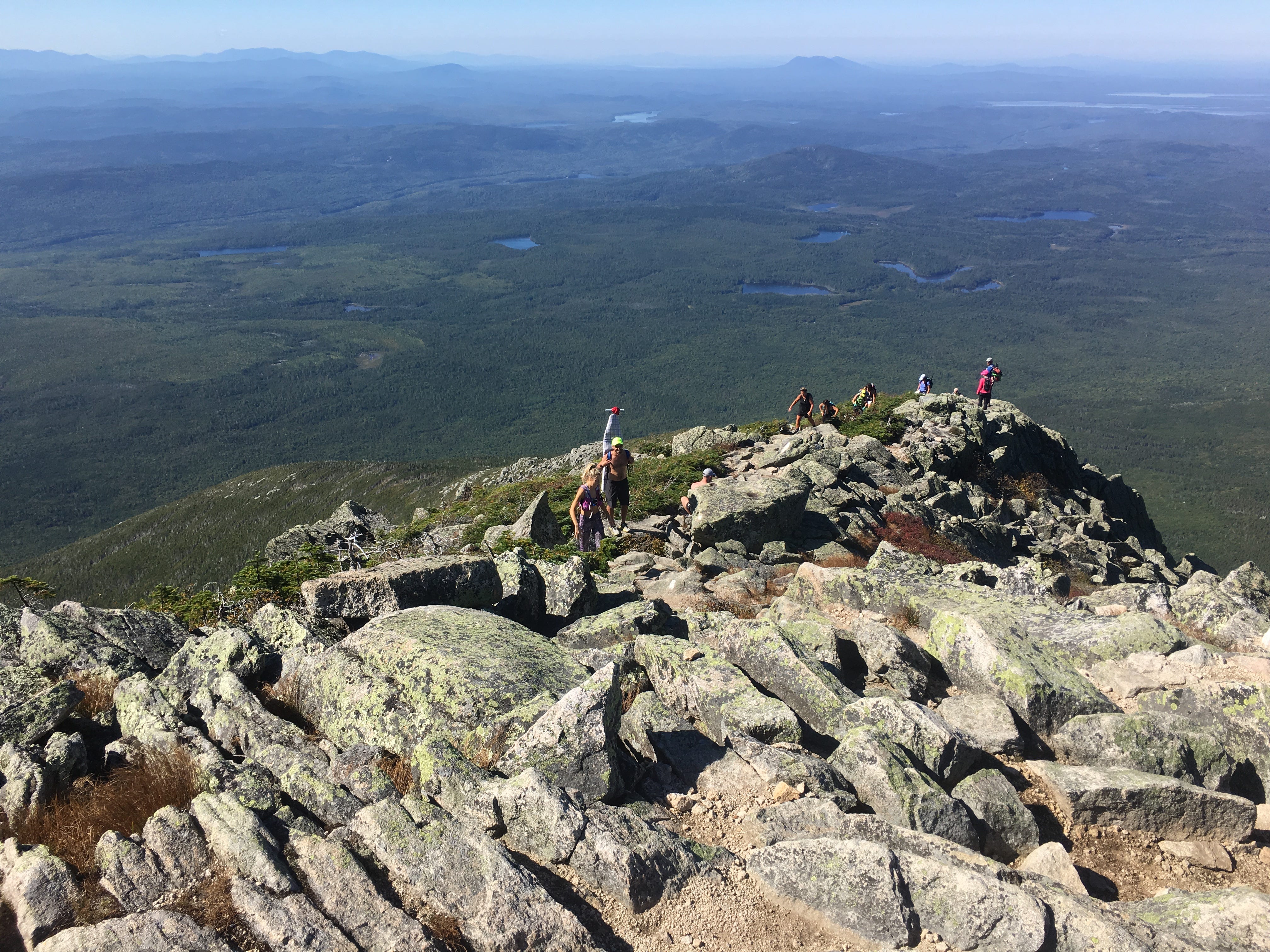
I peeled off my fragrant tank-top and handed it over. And that was when I found out that setting up an ironing board on Katahdin was a summer tradition that the friends had been practicing for half a decade. “How’d you come up with this idea?” I asked.
The Canadians looked at each other, chewing on this for a beat or two, and then the blonde woman turned back to me and said, “You know, I really can’t remember.”
My hunch is that you’d get a similar answer from Alton Weagle if he were alive today; if some reporter from the New York Times cornered him in a pub and asked him why he decided to walk backwards up the Mount Washington Auto Road. Or perhaps his response would be a version of what Philippe Petit told the press just after getting arrested for walking on a wire between the World Trade Center towers: “There is no why: When I see a beautiful place to put my wire, I cannot resist.” Maybe that’s how Weagle felt about the windy, winding road to New England’s highest place, or how those Nova Scotia hikers looked at Maine’s great mountain. I’d imagine millions of us have a special place where we can’t help but realize our most bug nuts dreams. Next spring, I plan to find out if the Mount Washington Auto Road belongs on my shortlist.
Perhaps I’ll see you there too?
Now, to close us out, here’s a lovely song about Alton Weagle Day from Dan & Faith!