
They took care of their own
Desertion and solidarity in the woods of colonial New Hampshire

A couple of weeks ago, two friends and I were watching Peter Jackson’s Lord Of The Rings trilogy; my thirtieth viewing, at least, and my housemate Emma’s first. And as we made our way into the climatic battles in The Return Of The King, I was struck by how many of the ensemble characters are driven by the will to fight for Middle Earth. Even the hobbits, small in stature and raised on leisure, find internal depths of bravery that surprise them, as they take up swords and take on legions of orcs and goblins. The original books by J.R.R. Tolkien, and Jackson’s masterful film adaptations, are largely about courage and perseverence in the face of fear that’s entirely reasonable—like watching your verdant corner of the world burnt beyond recognition. At a moment that’s existentially dangerous, courage and hope are two of the most vital resources.
But what does courage look like during a war of aggression? A war of choice, where the stakes are measured in dollars and extractions? Naturally, I’ve spent a lot of time thinking about this during the last few days—particularly when I watched toxic, black clouds form over Tehran (a metro area with over 14 million residents) after American and Israeli forces blew up several of the local oil refineries. Even during the carnage of the Iraq invasion, energy infrastructure like refineries was largely spared from bombs. Not this time around, with Defense Secretary Pete Hegseth promising “Death and destruction from the sky all day long,” like someone furiously jerking off in public.
During a war like this, does desertion become an act of courage?
It’s a provocative question that I’ve been mulling, starting around the time when the U.S. started double tapping alleged drug boats in the Carribbean; blowing them up, and then circling back to kill any survivors. This was when Arizona Senator Mark Kelly, a retired Navy pilot and NASA astronaut, took the unusual step of vocally imploring military service members to disobey illegal orders. It was cathartic to hear this from a standing Senator and a veteran, and I would imagine that it may have planted seeds which could germinate as the Trump administration’s war against Iran expands and escalates. Whatever resistance manifests could take many forms. But I suspect that when faced with the prospect of becoming an accomplice and a statistic in a war of aggression, some people may choose to walk away, by going abroad or into hiding.
Historically, desertion in wartime has been viewed as one of the most contemptible, cowardly things that a person can do. Choosing physical or spiritual self-preservation at a moment when others are putting their bodies on the line for The Cause. During the American Civil War, the Union Army paid bounty hunters to track down deserters and deliver them to the courts, where they were sentenced to hard labor or death. In the southern states, desertion became such a crippling problem for the Confederacy that militias known as the Home Guard were dispatched to ferret out deserters and kill them on sight. Those of you who’ve read Charles Frazier’s Cold Mountain or seen the Anthony Minghella adaption may recall the Home Guard as the main antagonists of the story, which is about a Confederate soldier who decides that he’s had enough.
But there are other, lesser known tales of what happened to deserters during the dark chapters of U.S. History. Last week, I walked into one in Londonderry, New Hampshire.
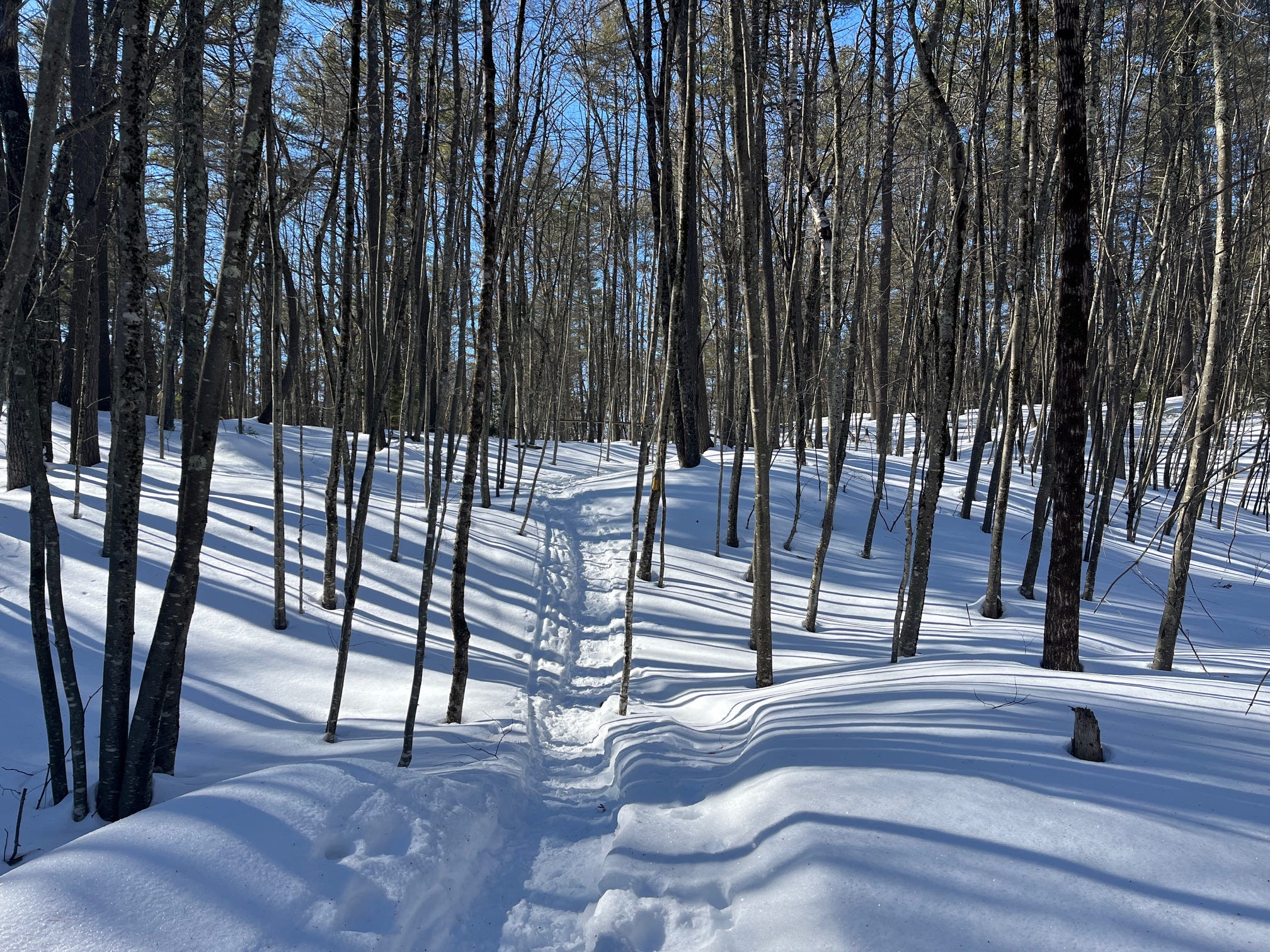
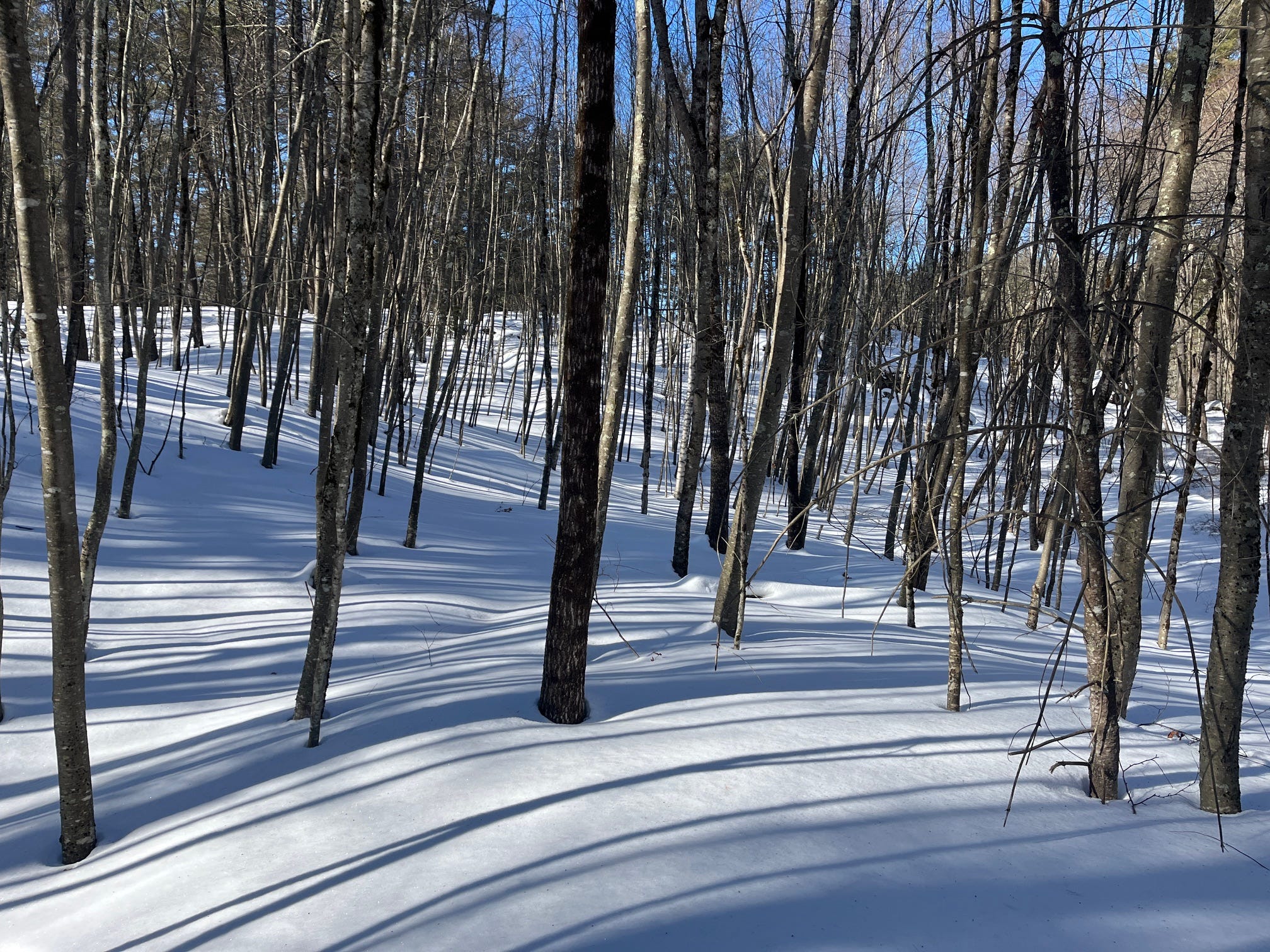
The southernmost woodlands of the Granite State are a strange place where suburban development is buffered by vast parcels of sticks and water. One of these green blobs, less than 20 minutes from the Massachusetts border, is the Musquash Conservation Area—a 1,000-acre menage of deciduous forests and bogs, which you can roam on a trail network that exceeds 20 miles. I first wandered through this space on a purple-ish summer night in 2020, while seeking a respite from the pandemic in the only northern New England state that hadn’t imposed restrictions for incoming travelers. I was a bit too distracted and stressed to really appreciate its immersive beauty back then. But I held onto the memory long enough that when I found myself needing to test a new pair of winter hiking boots on powdery ground, a return visit in March sounded nice.
In the late 1760s, a small group of the British soldiers who had been dispatched to the colonies to quell frustrations over taxation without representation found their way to Londonderry too. They were also struck by the bucolic charm of the area, to the point where they decided to find accommodations and shack up locally. In other words, the soldiers abandoned the cause of keeping the colonies in line, joining them instead. A 2024 Concord Monitor story by Ashley Miller sheds some light on the moment, thanks to archival digging, and while it’s hard to know exactly what may have inspired these British soldiers to desert, I can take a few guesses. By 1769, it was clear that colonists’ frustrations with the British Empire were reaching a boiling point; that violent conflict could be on the horizon. In a dangerous climate like this, any solider has to ask what they’re willing to suffer or give, between the punishing working conditions of wearing the uniform, to the possibility that your life could be a footnote in a chapter of history that people talk about in hushed tones. And then there’s the matter of the other lives that a soldier might find themselves tasked with extinguishing, when war breaks out.
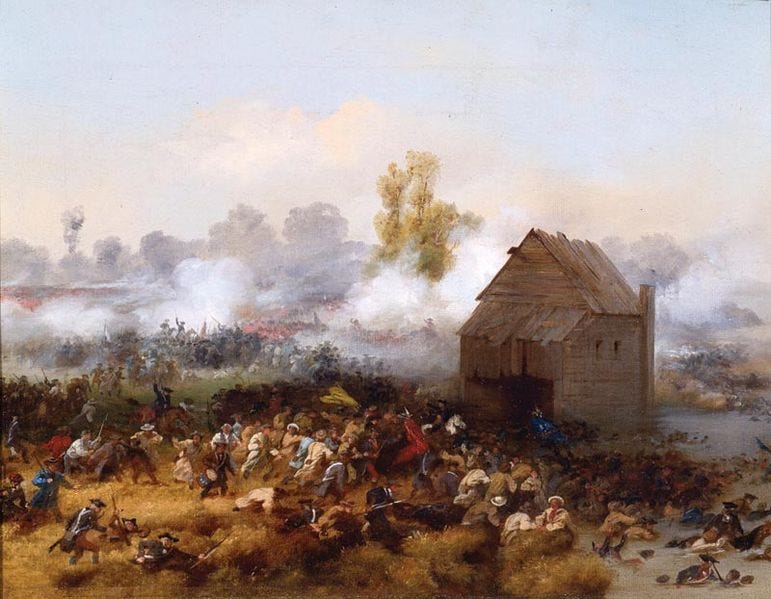
While we don’t know when and how the British deserters started breaking bread with the townfolk of Londonderry, what happened shortly after their deseration illustrates how successfully these soldiers had ingratiated themselves to the town. (Population: 2,590.) Somehow, word got out that Londonderry was harboring the soldiers, and a unit was sent out to arrest them. But as the British army detained the deserters and began marching them out of Londonderry, something remarkable happened. As Miller tells it, 11 villagers—some of them veterans from the French and Indian War—grabbed their guns, crashed through the woods, and intercepted the soldiers. They managed to free the deserters without firing a single shot, and after bringing them back to town, the conflict was pretty much settled. The British army didn’t send in another detachment to find the deserters again. (They had bigger fish to fry.) New Hampshire’s Governor at the time, John Wentworth, did his part to help the British upon learning of the so-called Londonderry Riot. At one point, he had the region leafleted with written warnings about the punishment for harboring deserters. And yet, no one gave up the Londonderry deserters. Presumably, they continued living in Londonderry to the end of their days. Or at least, to the end of the Revolutionary War.
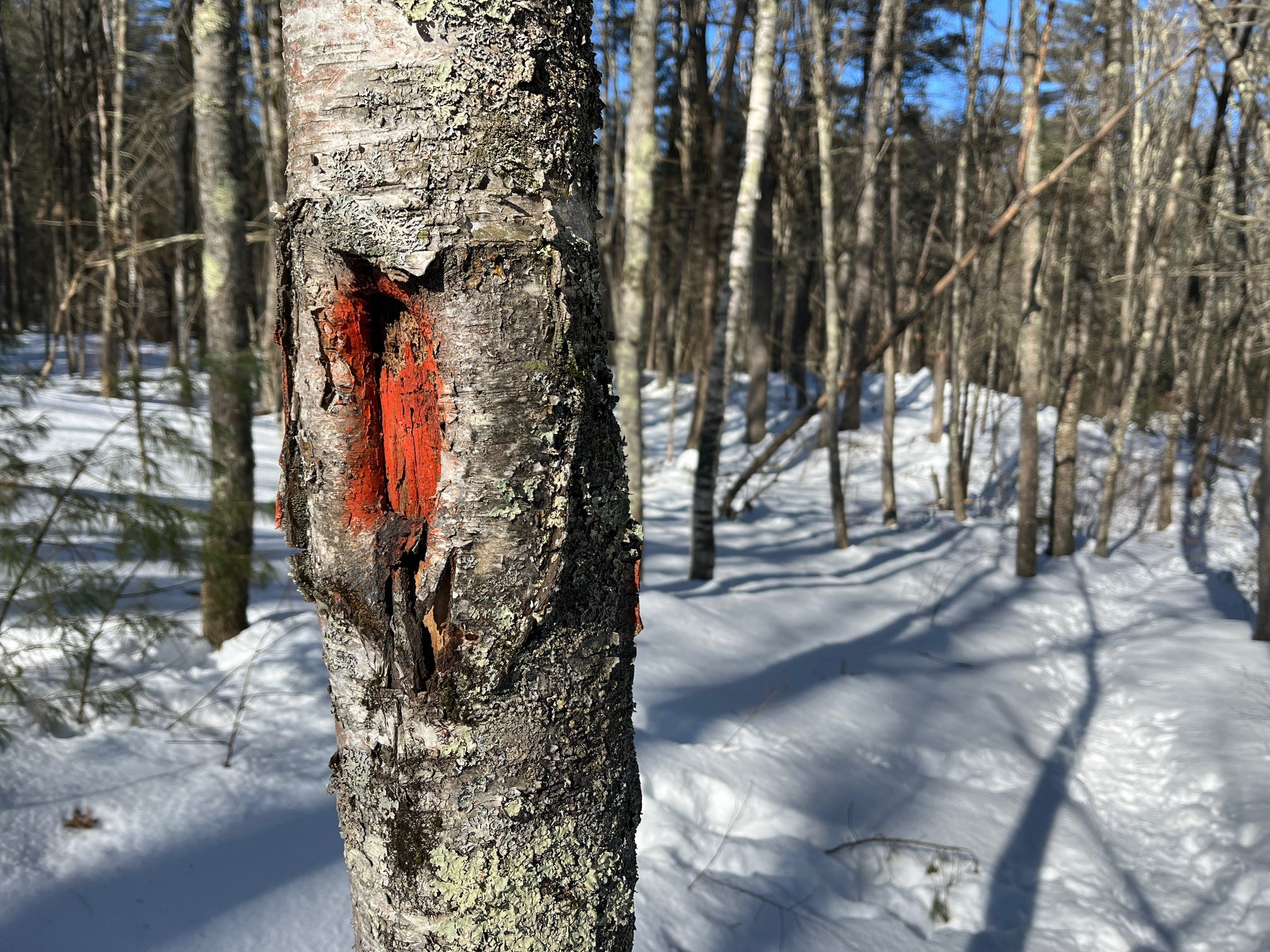
If you want to explore the 2.6-mile Betty Mack Loop, which encircles the heart of the Musquash Conservation Area on a mix of dirt paths and creaky boardwalks, you have a few options for where to pick up the trail. I chose a short connector path branching off from Sarah Beth Lane. Initially, it follows a power line corridor before veering right into the forest. And through the trees, I could see the back decks and palatial yards of the houses built on the periphery of the forest. And something that I noticed about a few of these houses was that they appeared to have rather large finished basements; the type that you can enter through a door at the back end of the abode, beneath the deck. Back in the time of King George III and the Londonderry Riot, deserters who hid out in southern New Hampshire had a lot of options for hiding spots—the livable kind where you could have your bed and provisions, and the more urgent refuges in which you might squirrel yourself away if a garrison or a militia suddenly marched into town.
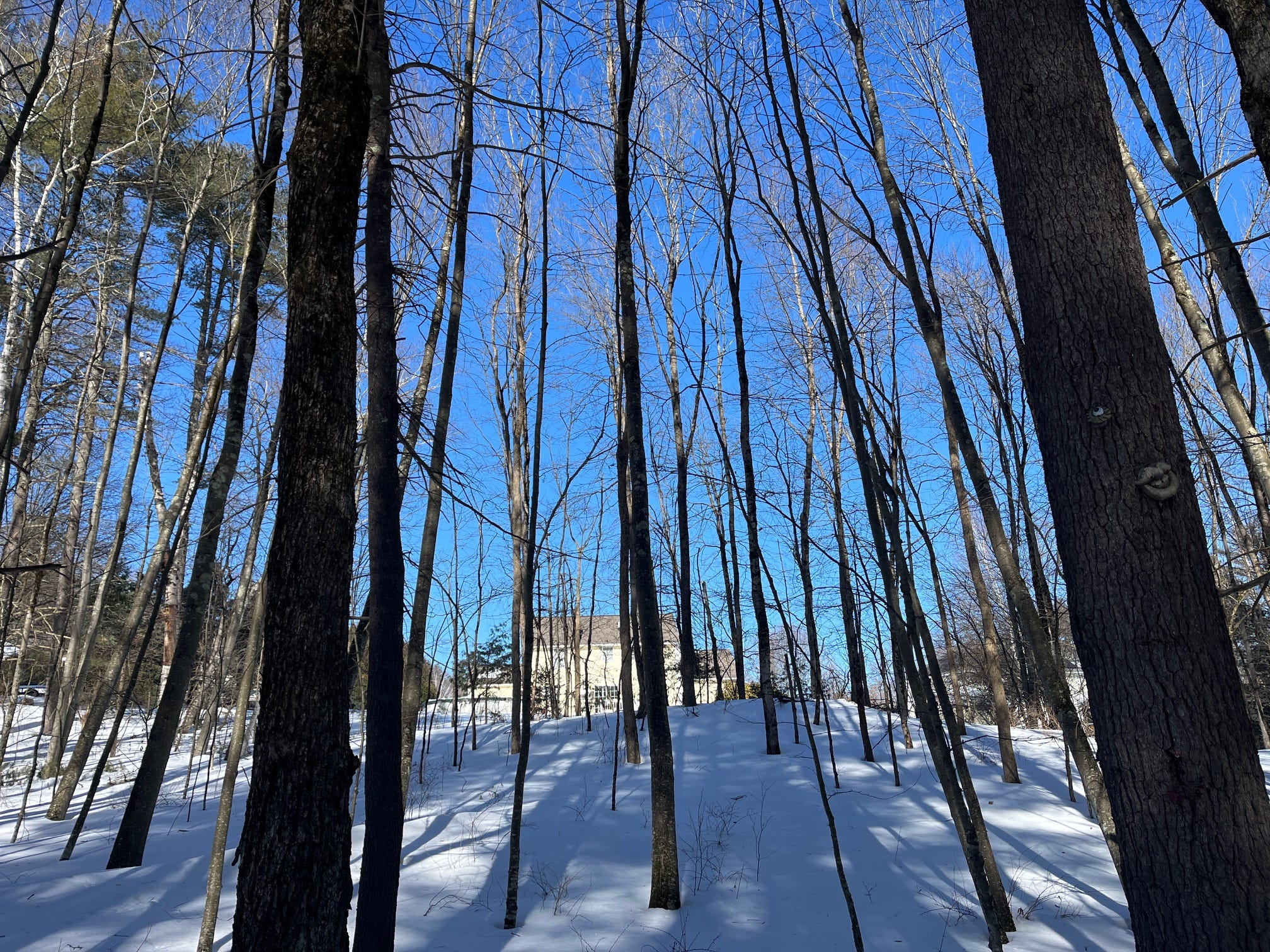
In present day Londonderry, a large basement in a house on the edge of a 1,000-acre wood is a space that might provide a similar cloaking effect, amidst a landscape that’s now replete with security cameras and digital infrastructure that can be used to track one’s footsteps. I imagined what it might feel like to spend indefinite weeks or months in a basement, not unlike those who found themselves quarantined in one during the worst times of the pandemic. I thought about what emerging from the basement for a walk in the adjacent woods could feel like under the newer context of an unjust war, which some will refuse to participate in—at their own risk. When it becomes clearer that this is happening, in our own backyards, I wonder what will resonate harder with Americans: the false solidarity of unity during a time of cruel and bellicose leadership, or the real solidarity of taking care of your own, in the face of psychotic governance.
Like Londonderry did, before America was a thing.
CLICK HERE for a trail map of the Musquash Conservation Area
Thanks for sharing ☺️🙏🏼
The jump from Tolkien to modern conflict works because you don’t force the analogy - you let it sit there long enough to become uncomfortable. That line about courage and hope being “vital resources” lands, but what follows is where it actually becomes interesting.
The part that stuck with me is the inversion at the end: questioning whether not participating could be the courageous act. That’s where the piece separates from standard commentary.
One thought: you’re circling something structural but don’t fully name it. There’s a difference between:
• courage inside a shared narrative (LOTR: defend the world)
• and courage in a system where incentives are unclear or misaligned (modern war, economic framing, distance from consequences)
That gap is doing most of the work in your piece.
I’ve been writing about a related idea from a completely different angle how environments quietly dictate behavior and what feels “right” in the moment. In travel it’s benign. In conflict, it becomes dangerous because the same mechanism normalizes things very quickly.
Your piece hints at that, but doesn’t fully push it.
Curious: do you think desertion becomes courage only when the narrative breaks, or was it always that and we just label it differently depending on who wins?
Jay says the same thing every week when we finish Mind the Moss, “He is fucking BRILLIANT!” and I could not agree more, another beauty, Milos, this one will stay with us