
Tick Watch
Unfortunately, we need to talk about these persistent buggers

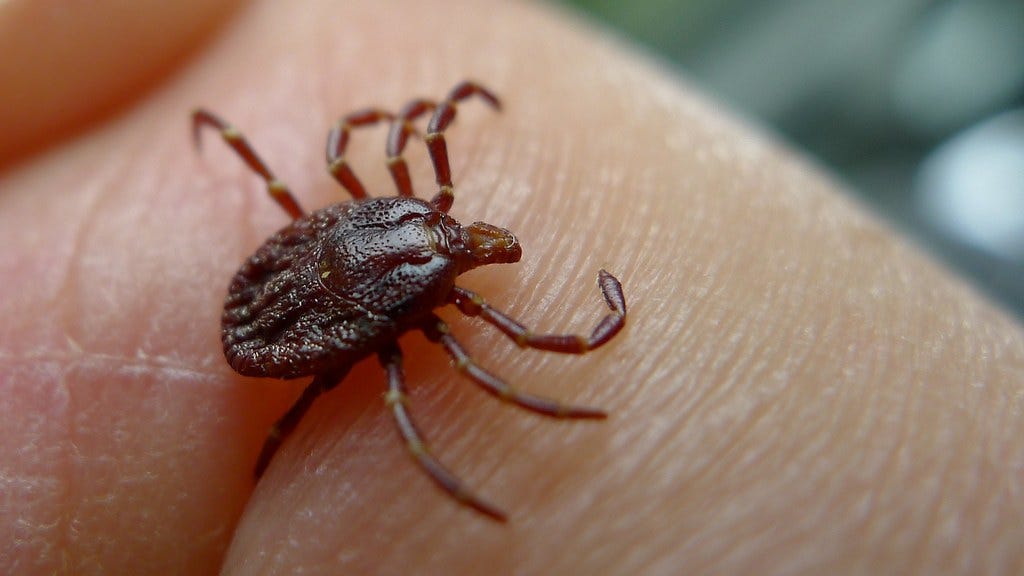
Around this time last year, I was on the southwest coast of the United Kingdom, on a story assignment that had me walking through thigh-deep grass in rolling farmlands and disappearing into roadside hedges, Homer Simpson style. When I got back to my Airbnb at the end of the day’s end and peeled off my sweaty clothes, I found a tiny, black-legged Sheep Tick (the equivalent of a Deer Tick in North America) hitching a ride on my left calf. But as I rifled through my bag for a pair of tweezers, I wasn’t hastened by the sense of red-hot urgency that often comes with discovering an embedded Deer Tick when you’re in America.
That’s because over in the U.K., the tick-borne illness known as Lyme disease is still relatively uncommon. According to the U.K. Health Security Agency, 2025 saw 1,168 confirmed cases of Lyme within the country, which is home to 69.9 million people. In the United States, however, the Centers for Disease Control and Prevention estimates that about 476,000 Americans are diagnosed with Lyme yearly. Proportionally, that’s 0.0014% of our population, compared to the U.K.’s 0.000019%
All of which is an elaborate way of saying that Lyme disease—which can cause a vast range of symptoms, from flu-like fevers, headaches and chills, to more serious joint swelling and neurological disruptions, is a serious problem for Americans who enjoy spending time outside. Even the West Coast, once relatively spared from Lyme, is now experiencing the bacterial illness at higher transmission rates. If you live on the East Coast or in the Midwest, odds are you know someone who had a miserable round of Lyme in the wake of a tick bite.
In New England, where I live, deer ticks are so eponymous to the region that a lot of us now conclude any outdoor activity—a hike, picnicking in a park, even going for a bike ride on a trail trail—with a thorough tick check. Because the one silver lining with Lyme disease is that it takes its sweet time making the passage from an infected tick to the skin and blood vessels of the tick’s host. If you remove a tick embedded and engorged within 24 hours of first contact, you should still save the tick in a Ziploc bag (seriously) and be ready to go to a clinic, in the event that the classic red “bullseye” rash appears around the bitemark. Or if you start to feel lousy, right after being bitten. But you’ve probably dodged Lyme disease.
But the reason why I am dedicating this week’s Mind The Moss to ticks and the nasty things they carry is because an alarming number of folks on the Eastern Seaboard are now dealing with another type of tick-borne nightmare: an allergic condition called Alpha-gal syndrome that’s delivered via the bite of the hyper-aggressive Lone Star Tick, which is found in the Eastern United States and Mexico. (The female ticks sport a telltale white dot on their reddish-brown bodies, and both female and male Lone Star Ticks are larger than Deer Ticks.) Alpha-gal is a sugar molecule found in red meats, dairy goods, and other products made from mammalian matter; such as gummy candies or pills that contain gelatin. But it’s also found in the saliva of some Lone Star Ticks, and when the Alpha-gal molecule is introduced to the skin and bloodstream—as opposed to the digestive system—it can essentially reprogram your body to mount an allergic reaction to Alpha-gal in its edible forms. This could be hives or nausea…or anaphylactic shock.
We’re still learning about the permanence of Alpha-gal syndrome. Some patients have actually experienced a decline in their symptoms over time, and not every person who develops Alpha-gal syndrome will experience the same allergic symptoms. But the thing that’s inspiring me to crank up my tick prevention practices for 2026 is that Alpha-gal syndrome does not come with a Lyme-esque 24 hour window for detecting and removing an infected tick, before the Alpha-gal molecule is transmitted. In fact, it can take weeks after a tick bite for an allergic response to Alpha-gal to develop. And once the rewiring is done, allergic symptoms can appear hours after consuming mammalian products, since Alpha-Gal molecules are attached to fats and proteins that take longer for the body to process.
My point being, Alpha-gal syndrome is serious shit.

Still, the last thing I want to do is leave you with the impression that the outdoors is to be avoided for the indefinite future. Ticks and their illnesses are, unfortunately, part of the ground reality that spending time outside is always going to carry some level of elemental risk that can’t be fully eliminated. And the current spread of Alpha-gal in locales like Martha’s Vineyard is a natural moment for millions of us to reassess what we’re doing to mitigate the risks associated with being outside in veritable Tick Zones.
So this week, as we head into the hazier months of summer, I want to break down the steps some of us are taking to lower the chances of being bitten by the wrong tick. And I share all of this with the caveat that even the best defenses can be overcome by one determined insect. In the same way that Pacific Northwest residents live with the reality that their region is overdue for a terrifyingly massive earthquake (and tsunami), we will continue finding ways to share these lands with the ticks.
A lot of this work will be more of a mental exercise—finding a balance between understanding what’s out there, and actually going “out there” ourselves and enjoying it.But the more practical steps that one can take to ward off the ticks this summer and fall are things that you can try this weekend. Some of them will require a bit of spending, and others might feel burdensome at first, when adopted on your next walks or outdoor experiences. But for now, the following Tick Watch practices are the best that I have to offer. On top of standard defenses like wearing high socks and/or long pants in tick-y areas.
#1: Turn your clothes into shields. When venturing into environments that ticks love (tall grass, bushes, and areas with lots of forest detritus), I sometimes spray my shoes, socks, and legs with insect repellent made to ward off ticks. The active ingredient for tick deterrence varies. Some sprays contain DEET, which can sometimes cause skin or eye irritation, and others utilize less polarizing alternatives like Picaridin, a synthetic inspired by black pepper plant compounds. Spritzing yourself and your clothes will keep ticks at bay. But this year, you can also up the ante with another bug repellent product that can transform your hiking clothes into shields that kill ticks on contact.
This product is Permethrin, a CDC-approved insecticide that can obliterate ticks by making their nervous systems go haywire. You can buy Permethrin by the bottle and spray it onto your shorts, socks, etc. (Don't spray it on your underwear or hat, as you don’t want this stuff close to your genitals or eyes.) Once you’ve air-dried all your treated clothing, the application process is complete and the tick protection can last for five to six laundry cycles before re-application is needed. There’s also a company called InsectShield that allows you to mail in your clothing for Permetherin treatment that lasts much longer. This option can be particularly advisable for anyone with a cat, since Permethrin is highly toxic to cats in liquid form. Once the Permethrin has dried, this is no longer an issue, but you should still keep Permethrin treated clothing away from cats; you might even consider washing it separately from your usual machine.
Lastly, never apply Permethrin directly to your skin. It’s strictly meant for garments.

#2: Embrace the mid-activity tick check. Most people tend to perform their tick inspections once they’re done recreating outside. And while it’s always a smart idea to take a good, thorough look at standard tick hangout areas like the backs of your knees, your armpits, or behind your ears, you don’t need to treat the tick check like a one-off coda. Periodically checking yourself for ticks while you’re actually engaged in an outdoor activity can be simple yet effective means of catching the little buggers before they have an opportunity to dig in. I do this all the time when I’m out hiking.
It’s less of a headache than it sounds like. Every 10-15 minutes, while walking outside with exposed legs, I’ll take a quick peek at my ankles, calves, knees, and lower quads, scanning the skin and the fabric of my socks and shorts for ticks. If I spot one and if it hasn’t latched on yet, I flick it away. If the tick has already gotten a bite…not great, but I can still use a pair of tweezers—which I do recommend carrying—to carefully remove the tick without detaching the head. (The CDC has a helpful guide for how to do this.) You can apply a similar practice to any exposed body parts while outside. And if you just finished walking through a field where the grass was waist-high, you might as well take a quick look down your shirt and other garments as well. It takes all of 5 seconds.

#3: Consider quarantining used outdoor clothes. Long pants and socks are a time tested defense strategy for ticks, but the bugs can also find plenty of places to hide on and within such garments. And when you get home after an outdoor adventure and you fling your clothes into a hamper, there’s not much stopping a stowaway tick from finding its way from your laundry repository to your bed or armchair. I know a couple of people who will toss their fragrant outdoor clothing right in the washing machine when they return from tick-heavy environments, activating a hot wash cycle and then drying the clothes on high heat for the first 10 minutes to kill unwanted hitchers. Since I live in a building with a shared washing machine that’s often in use, I take a different approach—if I’ve been hiking in a tick country, I put my clothes in a large plastic bag and I seal it shut. This is where they remain until I can wash them.
This might seem excessive and perhaps it is. But on more than one occasion, I have upended a hamper full of laundry into a washer, only to find a persistent tick in the hamper, stuck to the inner wall and holding out for its next meal. And one of the subtler benefits of quarantining your clothing after spending time in a tick-infested locale is that you can temporarily forget about your clothes—and the ticks—once the bag is sealed shut. And that’s the thing about living with these ticks. We have to afford ourselves as many opportunities to forget about them as we reasonably can, even in the face of ongoing tick-borne hazards like Lyme disease and Alpha-gal syndrome.
That's what pretty much every method of tick deterrence is doing; buying you just a little more time that you can devote to being outdoors and loving it. So be careful out there in the weeks ahead, my friends. And if you discover any new ways of warding off ticks that you feel like sharing with the Moss readership, sound off in the comments!
In solidarity,
Miles
One thing I discovered is ticks practically run up your legs. They are much faster than I imagined they would be. So checking frequently on your legs is a good idea and they don’t brush off easily. You really have to actively pull them off even when they’re still in the process of looking for a good hiding spot to dig in. That’s why they’re so flat so they can stick to you even before they bite you.
Great post. I was actually excitedly waiting for your Boston loop trail to be published when I was taken down by anaplasmosis, another lesser known tick disease. A few things I learned from the experience:
1. Be extra careful on days when something else distracts you. I’ve been doing tick checks all my life but on the day I (likely) got exposed it was hotter than expected and I was really focused on getting water when I got home. I did do my regular checks, but I realized in retrospect they were likely sloppier than normal because I was distracted.
2. If you’re in Massachusetts, the state publishes some surveillance data here: https://www.mass.gov/lists/monthly-tick-borne-disease-reports
It focuses on ER visits (of which I am now one!) so it doesn’t catch everyone, but it’s still pretty useful to understand tick activity in the area.
They also link to more information about some of the lesser known tick diseases, which are good to know the symptoms of. I’ve lived in New England my whole life but didn’t know what anaplasmosis was until I tested positive for it.
Again, thanks for the article, great info to get out there!