
Traction-Adventure
Getting a grip and sustaining it through winter

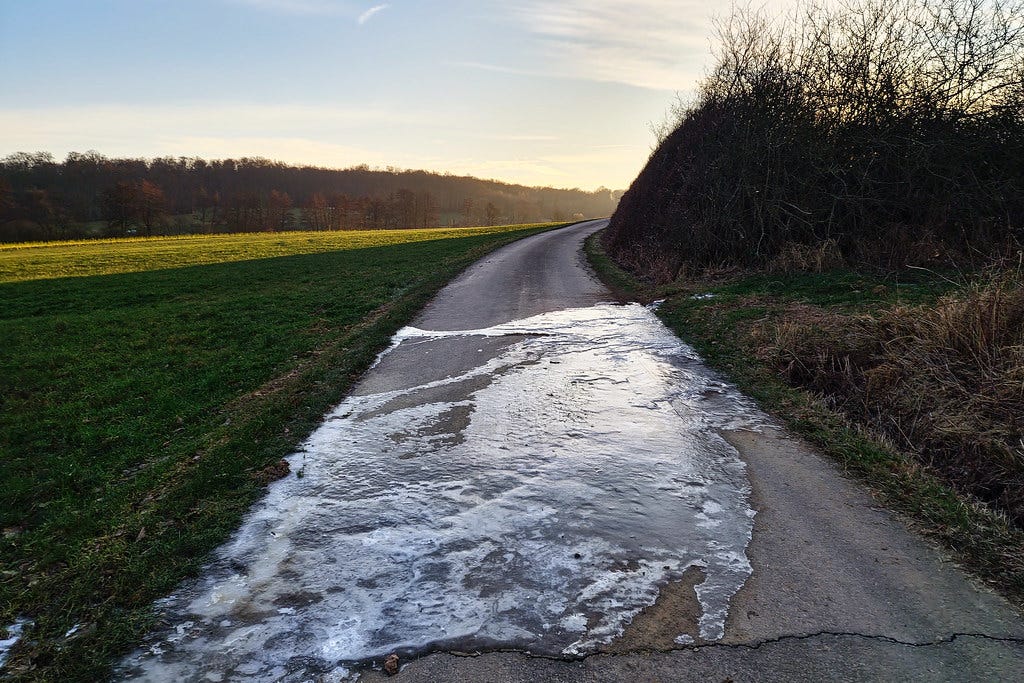
Of all the creative ways in which Minneapolis residents have been hamstringing ICE agents over the last few weeks, my favorite has to be the militarization of ice—as in, literal ice that forms within seconds in subzero temperatures. The thing you have to understand about people such as Department of Homeland Security Secretary Kristi Noem is that when they suddenly receive more than $170 billion in federal funding—as the DHS did last year—the money goes toward things like two Gulfstream G700 private jets, and not toward basic squad gear, such as footwear suitable for a winter city like Minneapolis. That’s why social media has been full of videos in which ICE agents are seen slipping and eating shit on ice while chasing Twin Cities residents. Some of the ice on the ground was naturally occurring, but other patches were the product of carefully-deployed buckets of water in areas with escalating ICE activity.
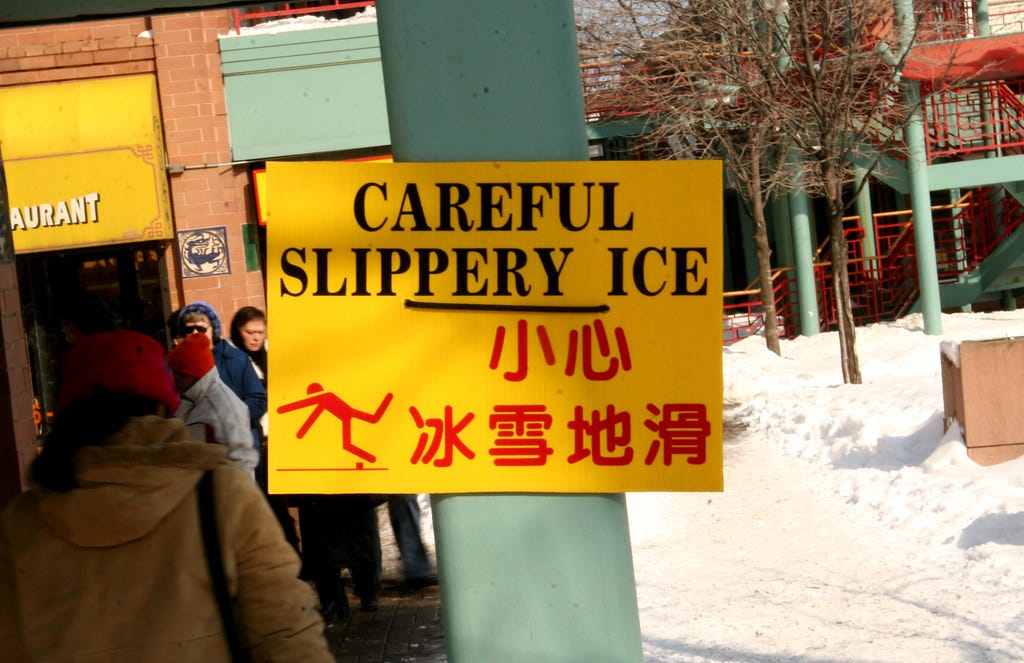
This is what creative grassroots resistance can look like, but it’s also a reminder that ice is one of the most understated hazards of winter. Each year, at least one person in my social network slips and lands hard on ice. Sometimes the result is inconvenient, like incurring a bone bruise, and other times, it’s completely debilitating. In August of 2021, I went on a few dates with someone who had spent the entire spring and early summer recuperating from an ankle fracture—which happened when she slipped an icy stretch of sidewalk that her landlord hadn’t salted yet. And with winters across the northeast getting soupier and less consistent in their conditons, those wretched days when every surface is glazed with bone-shattering ice are becoming more frequent.

Luckily, there’s something you can do about this; a tactical and material intervention that’s common in backcountry snow sports, but a lot less ubiquitous to the urban or suburban winter experience. If you live in a climate where ice is a recurring concern from December to April, then it’s time to start assembling a small arsenal of traction.
But before we begin, a housekeeping note. Those of you who’ve been reading Mind The Moss for a few years will know that I only write about outdoor gear on those rare occasions when it seems like highlighting a piece of equipment might help to address an acute problem or need. And I should also mention that I am not being paid by any manufacturer or PR firm to write about the gear that’s featured in the newsletter this week. (If any of you know someone who could make that happen, please hit me up!)
So…what is traction? It’s an accessory that you attach to the bottom of your shoe or boot; often a piece of flexible rubber that contains metal elements, which can dig into slippery surfaces like ice. Crampons—the razor sharp spikes that mountaineers use to scale snowcapped summits—are probably the form of traction that most people are vaguely familiar with. I find that ironic, because crampons are the monster truck of traction devices. Until we invent rocket boots, you can’t level up past crampons. And for somebody who’s just trying to get around town without slipping on sidewalk ice, crampons will be comically impractical. But just as there are trucks and cars more usable than a Monster Jam Megalodon, there are overlooked genres of traction that can be the difference between a more mobile winter, and winter spent in traction.
These are the ones that I consider to be the civilian-level “trilogy” of traction devices:
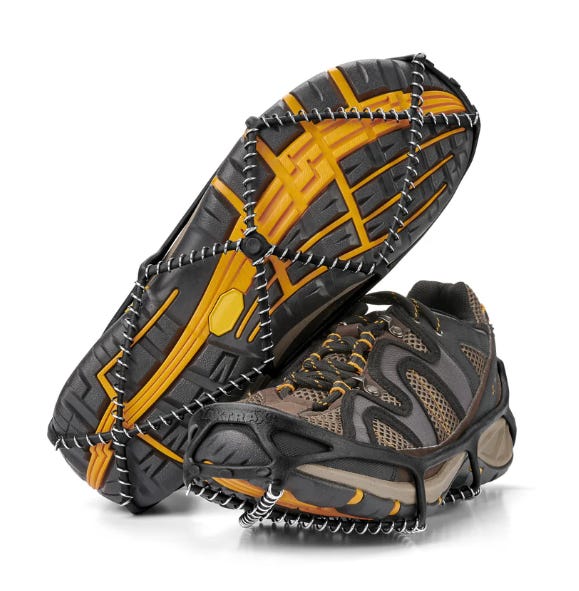
COIL TRACTION
Traction devices usually take one of two paths, and coil traction is the path that I’d imagine most of us have some experience with. Have you owned a pair of Yaktrax, or borrowed one from a friend? If so, you’ll recognize the structural design of a coiled traction device. It’s a slip-on piece of rubber, and the spiderwebby bottom that goes against the sole of your shoe features metal coils. And it’s the edges of those coils, combined with your bodyweight, that create traction and stability on winter ground.
Or at least, that’s the idea. I suspect that coiled traction like Yaktrax is one of the more common traction devices found in urban and suburban regions because they appear a world apart from the aggressive style of mountaineering crampons. And you can wear coiled traction without worrying about whether a misplaced footstep could pierce an artery in your opposite leg. The problem with coiled traction, however, is that people sometimes ask it to do too much. Coils tend to perform best on packed snow, when it’s still soft enough to dig into, yet still slippery. On ice, coiled traction is less reliable.
For that, you need something with bite.
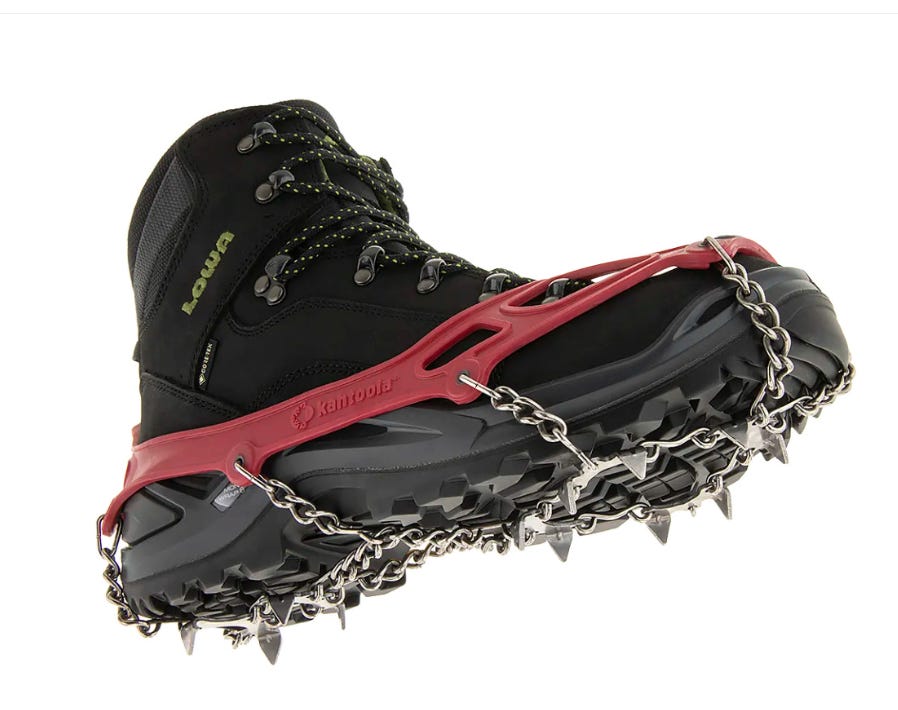
MICRO-SPIKE TRACTION
When you live in a glazed residential area and coil traction isn’t cutting the mustard, I guess it makes sense to wonder, “What if we could have a baby version of crampons?” That’s what micro-spike traction is—miniature crampons that you strap to your boot with the same flexible rubber that coil traction devices use. The spikes are duller and much smaller than those found on traditional crampons, but with the power of your footsteps, they can still crunch into solid ice in a satisfying way. Micro-spikes are a common addition to a winter hiking toolbox, but more of us are starting to discover how useful they can be after winter storms in places we don’t associate with hiking.
Still, there are limits to consider. Because micro-spike traction is a device with literal teeth, there needs to be a certain amount of ice that the spikes can fully pierce. If the ice on the ground is a half-inch thick or greater, you’re in micro-spike territory. But if it’s paper-thin black ice, you might have trouble staying upright with spikes on your shoes or boots.
The other challenge with micro-spikes is that their surface-breaking ability doesn’t just apply to ice. When I was an early winter caretaker at one of the Appalachian Mountain Club’s huts—Lonesome Lake Hut, in the shadow of Cannon Mountain—I constantly found myself asking hikers to remove their spikes before treading across the wooden floors of the building. But nobody’s perfect and a few times, I forgot to this when I returned to the hut after hiking. Once, I actually left a visible bitemark in the floor of the kitchen. (If anyone from the AMC is reading this, please don’t NARC me out to executive management.) All of this is a way of saying that if you wear micro-spikes, you have to be ready to take them off as needed. On some viciously cold, chap-your-ass day in February, that can grow really annoying.
But what if there was a happier medium between the gnashing of micro-spikes and the gentler grip of coiled traction? Something that you could strap to your footwear before going outside in winter weather and basically forget about, with each step on ice and snow? This brings us to the traction device that I use most often each winter.
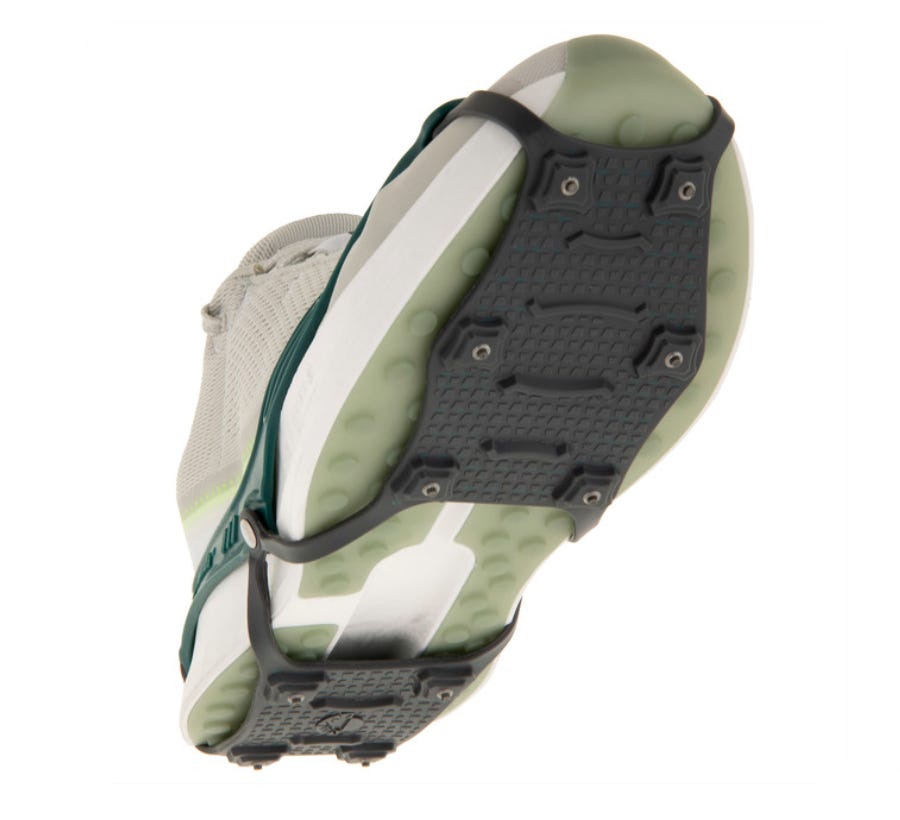
STUD TRACTION
Last January, when getting ready to lead scouting walks for Boston’s relatively new City On The Hills Trail (31 miles from West Roxbury to Castle Island!) I realized that I needed something a notch or two below micro-spikes, to safely navigate icebound parks and sidewalks. And a trip to the used gear section at my local REI yielded the solution—ice studs. It’s the same concept as micro-spikes and coiled traction, but in this case, the bottom of the strap-on rubber is dotted with tiny metal studs; sort of like the one that you often find at the tip of a hiking pole. The ice studs are modest enough that walking on clear pavement or on other hard surfaces doesn’t feel too weird, and the studs aren’t going to pierce those surfaces. But when you do bump into thinner stretches of ice, the studs dig in just enough to provide a safer passage.
While I wouldn’t trust ice studs to keep me from falling while ascending a seriously iced-up mountain trail, I’ve found them to be trustworthy on level-ish ground and stairways. And in the instances when I do forget that I’m wearing the studs, such as stepping onto the escalator at a subway station or ducking into a supermarket or a friend’s place, I don’t have to worry about leaving a trail of light damage in my wake.
So where does that leave you, as the potential traction owner and user? Should you plump for all three of the devices outlined above, or test the waters with just one? It really depends on the environment you live in, your budget, and your comfort level.
If you live in a city or town where the winters regularly bring ice into the picture, I would invest in a pair of ice studs and a pair of microspikes. This will give you the ability to toggle between different levels of ice density and coverage.
If you prefer to start with one device before spending more money on additional traction, go with the ice studs. (We’ll get to prices and models shortly.) This type of winter traction is the most versatile of the three models outlined above.
If winter conditions on the ground make you feel very uneasy, then you might as well spring for the entire trilogy of traction devices. Coil traction, while probably the least helpful, still works on packed snow, and it’s the cheapest.
These days, you can pick up coil, micro-spike, and stud traction devices from most big box retailers that offer recreational gear. And that brings us to pricing and brands. The widening popularity of micro-spikes and studs had flooded the online market with a lot of low-priced options from manufacturers that you’ve most likely never heard of. The advantage of going with one of these mystery brands is the price, of course. But they usually don’t offer much of a warranty. And since we’re dealing something that’s kind of elemental, like not slipping on ice and cracking your femur, you might want to consider purchasing your traction device from a more known and vetted manufacturer.
So here are the brands I recommend—after years of field experience—for each device:
For coil traction, Yaktrax still reigns. A limited 90-day warranty is included and the price from the manufacturer is $22. (But look for for better deals from other retailers.)
For micro-spike traction, Kahtoola leads the way. The warranty for these puppies is 4 years, and they come in larger sizes than other spike models do. The price is $84.
For stud traction, Kahtoola also crushes it. That 4-year warranty applies to their NANOspikes (which are really studs in their shape and design) and they run for $64.
One last thing, before I attempt to venture outside without making a mess of myself. It’s pretty easy to pick up lightly-used traction on Facebook Marketplace or Craigslist throughout the year—even during the height of winter! A lot of people buy this stuff with the intention to use it for winter sports like hiking, only to find that winter sports aren’t really their bag. And by then, the return window has usually closed. So they’re forced to pawn the traction off to the masses. You probably won’t be able to get the warranty passed over (you can always ask the seller if they still have the receipt), but scoring a pair of barely-used spikes or studs from a good brand for $30 is a victory worth savoring. Maybe with a crunchy, post-storm saunter to the local park or pub.
As a Bostonian moved to Norway a few years ago, I was shocked & delighted by the quantity of traction footwear easily available everywhere -- basically, any pharmacy will have a selection. I of course owned coil traction yaktrax but I had never seen the stud type which is very common here (even in kids sizes!). But the new kind I had never seen is like plastic sandpaper -- basically, enough to grip on mild ice but NOT damaging to indoor floors so you don't have to awkwardly take them off them you get to the grocery store or coffee shop etc. There's incredible engineering happening for footwear & America is missing out!!
Love how you connect this important daily winter hazard to the politics.