


I found it impossible to focus on anything yesterday. Plugging numbers into a project spreadsheet, paying credit card bills, and taking out the recycling felt less like routine tasks of daily living and more like an absurd way of coping with the ground reality that our president was threatening to destroy an entire country. “A whole civilization will die tonight,” was the beginning of what Trump had posted on his TruthSocial page at 8:06 AM yesterday. “I don’t want that to happen,” he added. “But it probably will.” Whether this was an allusion to dropping a nuclear bomb on Iran or leveling enough power plants and bridges to send the Iranian people “Back to the Stone Age” (Pete Hegseth’s recent words), being alive and aware the other day was a cascade of awful feelings. I wandered from rage to shame to anxiety that the world might actually end, if no one in the White House had the courage to rein in Trump’s homicidal impulses. It was clear that most members of Congress—terminally obsessed with re-election, and unwilling to re-evaluate their paths to victory—were not going to do anything; which is almost as horrifying as Trump’s genocidal rhetoric and the damage it will inflict on any prospects for peace and on the world economy. I’m also rather horrified that the Democratic Party mainstream’s response to Trump changing his mind at the eleventh hour is essentially calling him a pussy. All of this is reckless, stupid, and unsustainable.
For me and my buddy Adam, also reeling from everything, our day ended at a quiet bar, where I couldn’t help but wonder how many of the other patrons were calming their nervous systems with alcohol because of the news cycle or irrspective of it. The healthier thing to do, which I’m trying to find the energy for this afternoon, would be taking a walk outside; something I’ve recommended time after time, whenever Very Bad Things happen. The boost of endorphins, serotonin, and dopamine may be short lived—I learned about Trump’s “civilization will die” post immediately after meeting another friend, Patrick Maguire, for an early morning walk around a pond in Boston. But at this point, we have to grab those boosts whenever and wherever we can; for the good of our health and our stamina. To say that we, as a nation, are in uncharted territory is describing the present situation lightly. I agree with Paul Krugman’s recent assessment that this is America’s “darkest hour;” that “the fate of the whole American idea is on the line.” I have a difficult time imagining this crisis ending in ways that are familiar and precedented. Nor can I picture America coming back from this without a big step in a new direction for America—culturally, economically, and governmental.
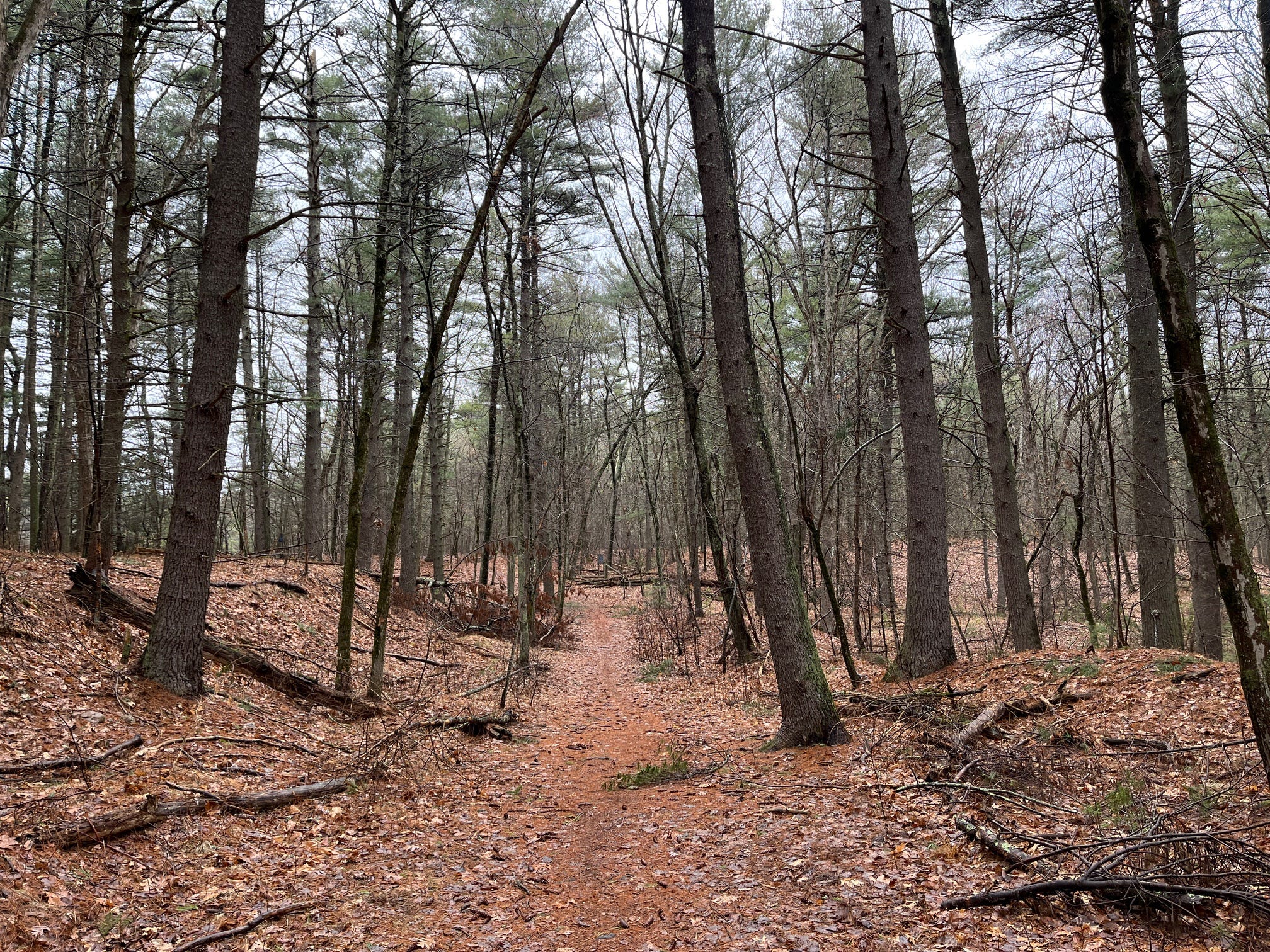
Reaching the edge of what’s familiar is a strange and sometimes scary exprerience. It means putting yourself in the way of chance, which can yield good things or go south. Stepping beyond that boundary doesn’t necessarily mean going into unknown space completely blind—usually, we have some idea what we’re getting into when we tread beyond our “normal” environments, whether it’s going on a birding walk with a bunch of strangers or trying a new sex position with a partner. But still, there’s often a pretty significant gulf between how we imagine these explorations playing out, and what they actually lead to. Once, when stopping in Worcester to search for a big rock in the woods that’s covered with fire and brimstone inscriptions, I ended up getting chased away by an angry dog from one of the houses near the edge of the forest. But more recently, a different and more local leap of faith opened my eyes to new possibilities that were hidden right under my nose for all the years that I’ve been living in Boston.
Since the price of gas is rapidly escalating across the world—making a weekday road trip and hike less practical for millions of us—I had been studying the commuter rail network map for Greater Boston. I was especially curious about the terminus of each route. I imagined taking one of the trains to the end of the line, setting off from the station platform with a backpack, and finding my way to someplace beautiful, weird, or unsettling. When the phrase “end of the line” is used in the context of train or bus travel, it often evokes this sense that a consequential transition is happening. When I hear or read the phrase, I think of Hayao Miyazaki’s Spirited Away, in which a journey from the world of the living to the afterlife is taken on a train that crosses the watery expanse of a dead-calm ocean. Or, if I’m in a saltier mood, I remember the beginning of Jim Jarmusch’s anti-western, Dead Man. Johnny Depp is riding the rail from Ohio to a new job in a town called “Machine,” somewhere in the Rockies. It’s not a good sign when the greasy train conductor (Crispin Glover) tells him “That’s the end of the line.”
The lack of commuter rail options from the station closest to my apartment made the decision for me, and the ashen clouds and sleety rain that materialized that morning didn’t feel like a great sign either. I spent about 20 minutes riding the train southwest from Boston to the adjacent suburb of Needham, which is separated from the city by the Charles River. Given that some of the other trains run all the way to Rhode Island or the North Shore, I was a little bummed to be taking an “end of the line” adventure that barely breached the Boston perimeter. But a quick look at a map while I waited for the train at least gave me something to aim for in Needham—a splotchy green chunk labeled “Ridge Hill Reservation” and a smaller, neighboring green blob marked “Needham Town Forest.” At the very least, I could walk from the train platform at the Needham Heights station to a pair of forests, for some spruce and granite therapy.
The first few minutes of my hike began on West Street, which took me down a steep hill—the literal height of land behind “Needham Heights”—which was covered with single family homes. When I’m walking through residential territory to get to a more grandiose green space, I often try to make the connective walk more interesting by identifying possible places of interest on the map, like a pocket park or a sculpture that I could dart by. My map of Needham Heights suggested that it might be fun to pivot from West Street toward a little water body called Rosemary Lake. Not just to see the lake, but to explore a short path that appeared to serve as a car-free bridge between the two places. On Google Maps, paths like these are often represented as thin green lines, and they’re routinely unnamed. At the bottom of the hill, I kept my eyes open on the left, searching for the beginnings of a walking path and expecting something fleetingly charming, like a stitch of oaks between houses. But pretty soon, it became clear that I was approaching something that the map had really undersold.
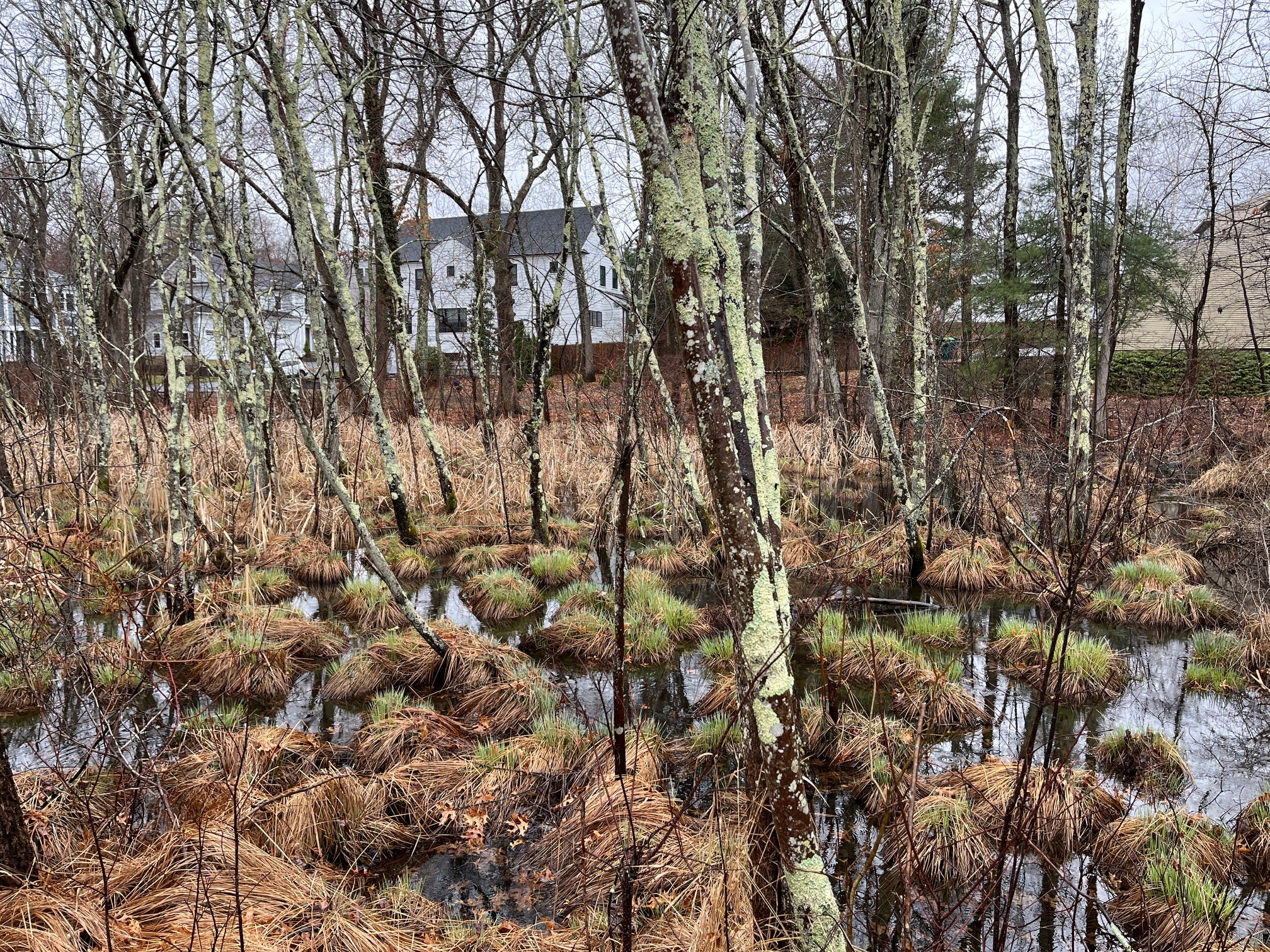
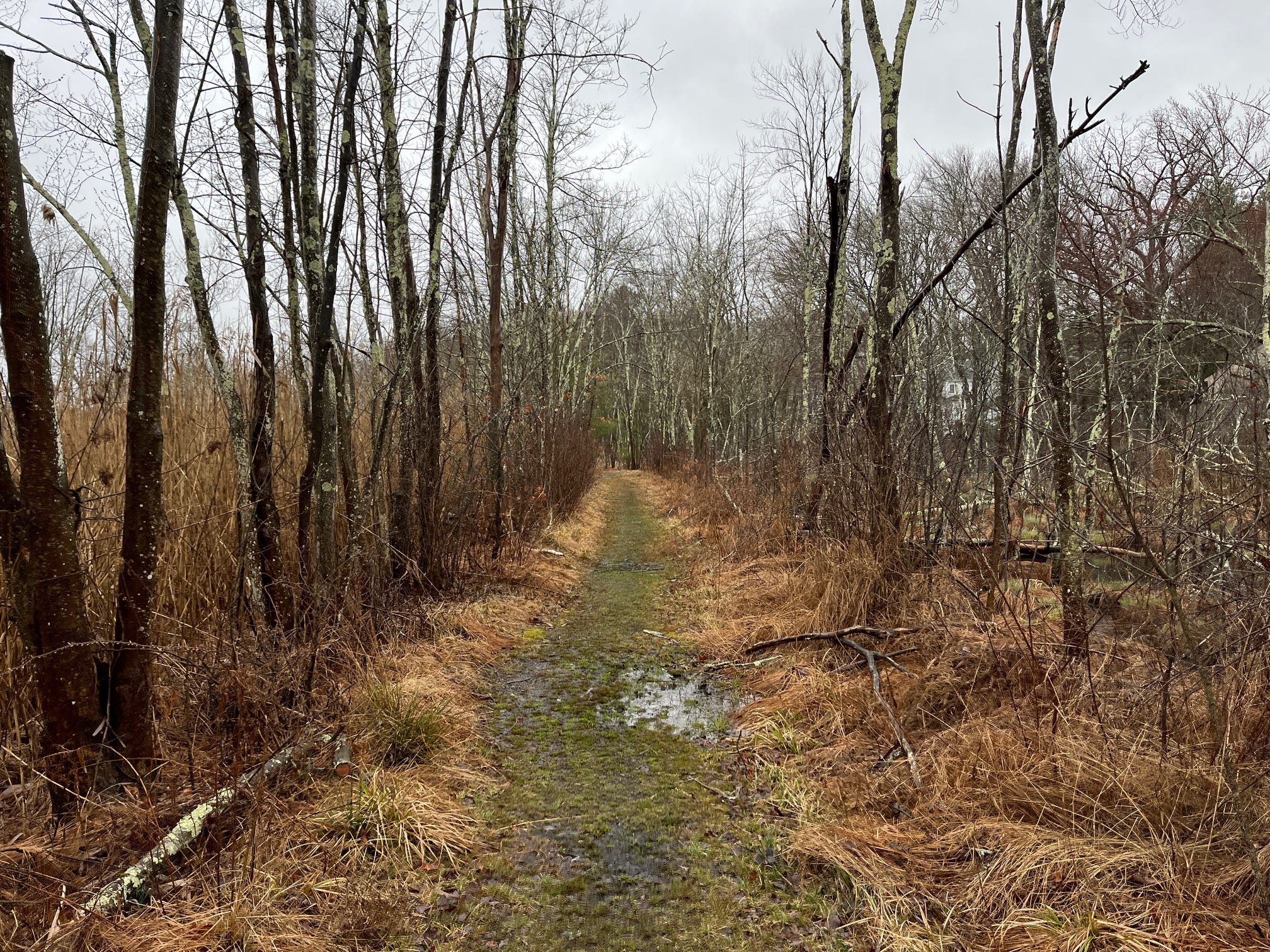
On the final stretch of its journey to the lake, Rosemary Brook sloshes through a vast bogland with twisted trees covered in bright green moss. It’s a swampy oasis tucked between town streets and developed land, and a grassy path runs straight through the bog—from the edge of West Street to the beginning of Tillotson Road. It seemed likely that this cross-bog path may have been a lost or unpaved segment of Tillotson Road. It was wide enough to accommodate a horse and buggy, if not a Ford F-150, and the Town of Needham was founded centuries ago in 1711. Whatever the case, I found the scale and color of the bog thrilling to behold. It was so unexpected that I ended up walking the cross-bog path three times. First, I used it to reach the north banks of Rosemary Lake, and the next two times were just for the sheer pleasure of walking down an unlikely hall of grand trees, past pools where skunk cabbages will soon be thriving. I had to remind myself to press onward to Ridge Hill Reservation.
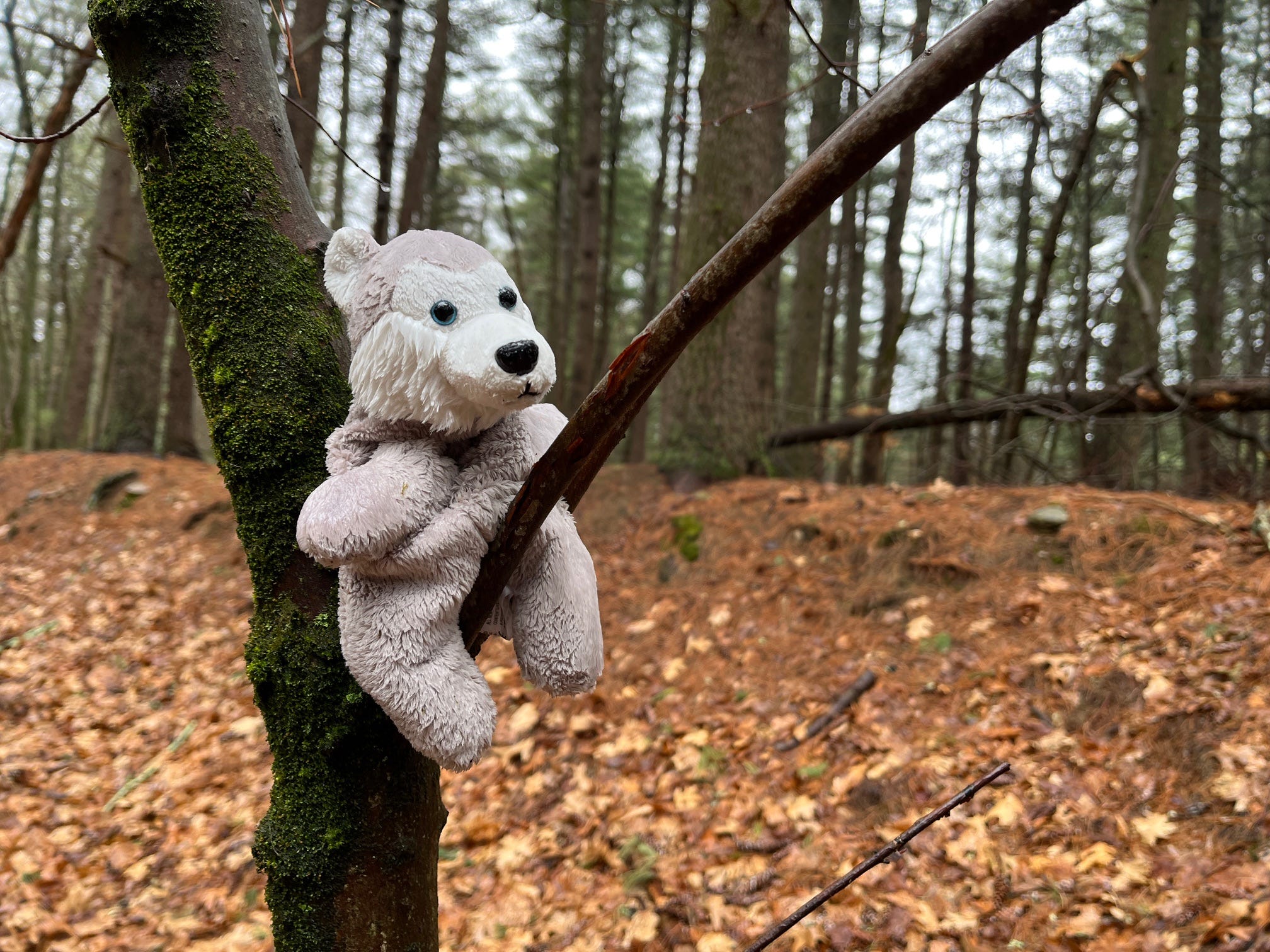
As I passed the lakeshore once again, heading westward toward the woods, I saw a lonely bike abandoned in the parking lot. I wondered if its owner was miles away, or down by the water’s edge smoking some weed. Perhaps this lake was a foundational place for them, but what might the periphery of their world—their normal—look like? Would it include the evergreen and deciduous expanse of a place like Ridge Hill? The 352-acre forest offered more seclusion from the burbs and the local highways, but it was a more predictable immersion, not unlike stepping into the trees of familiar green spaces like the Middlesex Fells or the Blue Hills Reservation. Stumbling upon the bog along Rosemary Brook had surprised me enough that I was now intent on detecting other surprises nestled in the landscape. Toward the end of my Ridge Hill traverse, I found a smaller one; a sodden stuffed animal that someone had positioned on a tree branch. There were no plush companions in sight, here or anywhere else on the trail.
The smaller Needham Town Forest, on the other hand, proved more bounteous. I entered the woods on the far west edge and I followed a squiggly trail through an especially lumpy section of the forest with mossy glacial boulders and pond-esque vernal pools. According to my map, the Needham Town Forest isn’t just municipal property. A chunk of these woods is owned by Scouting America (formerly the Boy Scouts of America) and the gnarly little trail I had just picked up was part of a camp frequented by Boy Scouts. The path struck me as an ideal place for introducing Boy Scouts or any young, beginner hikers to the rocky and rooty rigor of what to expect across New England’s open spaces. The placement of the trail, in such a chunky part of an otherwise demure town forest, felt intentional—like its creators wanted to use this tiny, hairier piece of the forest to offer a concentrated showcase of hiking with a capital H. I wondered if this could be replicated in other forests in cities and towns; a tiny trail that offers a generous taste of how grueling and messy a good hike can be.
The questions of how to make it easier for more people to get outside—and how we can break down real and perceived barriers—has rarely been more centralized in the outdoor recreation community. But answering those questions still requires treading past the end of our lines, seeing what’s out there, and considering the possibility that some of these things may be worth holding onto and exploring further. In doing this more often, we might change the course of things and “discover” opportunities and directions that were hidden in plain view. Even when life is good and most things are working out, a trip to the end of a line and beyond is an excursion worth taking. But when it feels like the world is ending and there are no obvious answers within reach, “beyond” is the only place left to go. We may be surprised by what we find out there.
Great essay as always. Next time you are in the Needham Town Forest, don't miss the magic of Martini Junction. Bring a kid or find your inner kid. Follow the tiny painted bird houses nailed up on tree trunks to guide you to a world of train tracks, trains, and toys. Look carefully for whimsical structures hugging the path, perched up on rocks and hiding in crevasses. Let your imagination go wild as you rearrange them to tell your story. Hunt for fun QR codes for background information.
You led me down a rabbit hole/memory with this essay. I grew up in Wellesley and Rosemary Lake sounded familiar. It turned out that while I was aware of its location (not far from the town recycling center) and had been near it, it wasn't the memory I triggered. That was a memory of learning about nearby Sabrina Lake and the Baker Estate.
From Wiki: In the late 1860s William Emerson Baker moved to Needham. A notably wealthy man due to his having improved the mechanical sewing machine, Baker assembled a parcel of land exceeding 800 acres (3.2 km2) and named it Ridge Hill Farm.[7] He built two man made lakes on his property, including Sabrina lake near present-day Locust Lane. Baker turned part of his property into an amusement park with exotic animals, tunnels, trick floors and mirrors. In 1888 he built a sizable hotel, near the intersection of present-day Whitman Road and Charles River Street, called the Hotel Wellesley which had a capacity of over 300 guests. The hotel burned to the ground on December 19, 1891.
https://backsideofamerica.blogspot.com/2018/01/the-fabulous-baker-estate.html