
Swimming in circles
A window to a future on the North Shore of Massachusetts

I didn’t think I was going to be able to publish Mind The Moss this past week because, well, the last two weeks have been kind of insane. I’m not sure where to start. I had to deal with multiple health emergencies—including one of my own, that almost led to a broken toe—and this meant dealing with all the structural problems and indignities of our for-profit health care system. And while I’m relieved to report that the crisis phase seems to be over (pounding hard on wood), I can’t say the same for what’s happening beyond the localized scope of my daily life. Our president is dragging us into a war of choice that’s becoming deadlier each day. The cost of everything we need to survive is getting higher and forcing people to make terrible choices. And here in Boston, we’re still bracing for the possibility of an ICE surge, like the one inflicted upon Minneapolis.
All of which is a way of saying that millions of us are hacking our way through a world of shit right now. And this would be overwhelming and exhausting enough if all these things amounted to a recent detour into chaos—a sudden change in topography after you’ve been walking through a gentler, placid landscape. But what makes the stress of 2026 even more burdensome is that it’s just the latest escalation of a prolonged time period that’s been shaped by mass anxiety, instability, and trauma. Some people will cite the 2016 election and Donald Trump’s first presidential term as the beginning of this chronic nightmare, when the wheels of daily living started falling off. Personally, I would point to the COVID-19 pandemic. Horrendous as Trump’s first term was, there were still some “guardrails” to protect the world from his most sadistic impulses. And the pandemic marked the end of any breathing room that people found during those first four years. It was a global crisis characterized by mass death, illness, and isolation. And I feel fairly confident in saying that millions us have not recovered from that crisis.
I was talking about this with my friend and decades-long hiking buddy George a few weeks ago—not long after I followed him into some scrubby woods in Plano, Texas. It was the final 15 minutes of our hour-ish call, the topic had turned from the alarming state of the world to a possible path forward, and George proposed an idea that you don’t often hear in American life. What if, before moving forward, we took a minute?
Think about the crises we’ve weathered over the last decade. Again, we’ll go with the pandemic as the Godzilla of these crises. When was the last time you saw or heard a national political leader or public figure create a space in which the enormity of what was suffered and lost during the pandemic could be felt and honored? In which the millions who struggled in solitude during the pandemic could finally feel seen for a moment, beyond the bounds of their respective lives? If you’re having a tough time identifying a moment when we did this on a national scale, well….I’m not faring any better than you are. Because we never really had an intentional moment for national acknowledgment of the pandemic. Just as we never had a moment to recognize the things that occurred during Trump’s first term and how dangerous those years were.
Instead, as is often the case when control of the government changes hands from one party to another, the Biden/Harris administration primarily chose to “look forward, as opposed to looking backward.” Those were the same words that Barack Obama used in 2009 to explain why he wouldn’t pursue investigations of war crimes that occurred on George W. Bush’s watch during the wars in Iraq and Afghanistan. While Biden and his team at least pursued prosecution of the insurrectionists who had stormed the U.S. Capitol and killed a police officer in January 2021, the first Trump administration and its architects mostly escaped any accountability for their actions. Just as the architects of the 2008 financial crisis, the Bush-Cheney wars, and other calamities were spared.
What this pattern yields is a dual-fold crisis of mental and civic health. When we fail to acknowledge a moment of profound, mass suffering—and the decisions that created this suffering or made it much worse—what we’re really doing is avoiding the work of healing. And that’s the thing which is often underappreciated in American life. Healing isn’t just something that happens with time. It takes a lot of intentional work, and this can be tough or even painful. It requires coming together to build something close to a consensus as to what happened, and what can happen next. In a personal context, it might mean talking with a health care provider and family members. But in a political context, this means more dialogue between elected leaders and communities, and an understanding that “looking backward” is often the first step of truly moving forward.
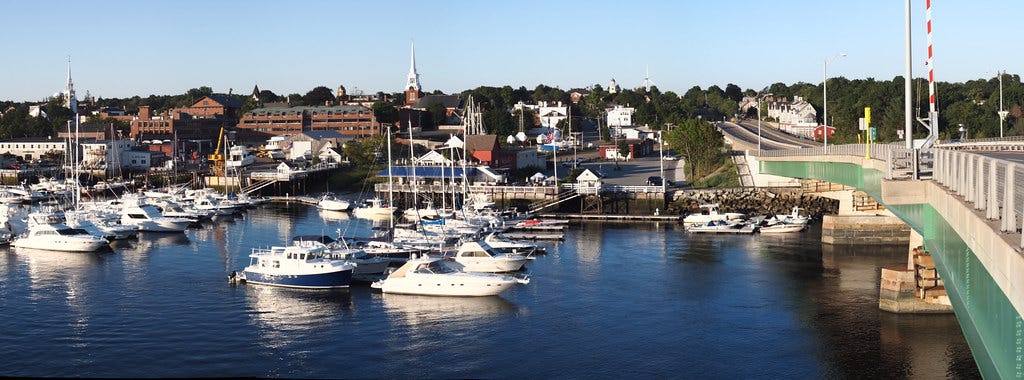
Last week, I took a short breather from the chaos and met up with my aunt Jorden for a walk on a trail that she had wanted to show me for months. The Clipper City Rail Trail is a recent addition to the North Shore realm of Newburyport, Massachusetts. It sets off from the commuter rail station outside the town center and it shoots through corridors of trees and power lines to the local Harborwalk. Right now, the Clipper City Rail Trail covers 3.9 miles, but it can be used as a means of connecting to additional rail trails and walking routes around Newburyport. Within a minute of hopping onto the trail from the Henry Graf Jr. Memorial Skating Rink (you can park here for free, if driving), we were encountering several forms of artwork and historic relics that have been staged along the trail. At one point, I posed for a photo in a replica of an early 20th Century steam engine. And a while later, as we segued to the waterside path of the Harborwalk, we found something else that inspired a literal moment of silence.
At first, all I saw was a wheel of dark granite, on which a school of white fish appeared to be swiming in circles. And then, I read the words. “For those who died and those who survived and all we lost during the COVID-19 pandemic. We shall remember.”
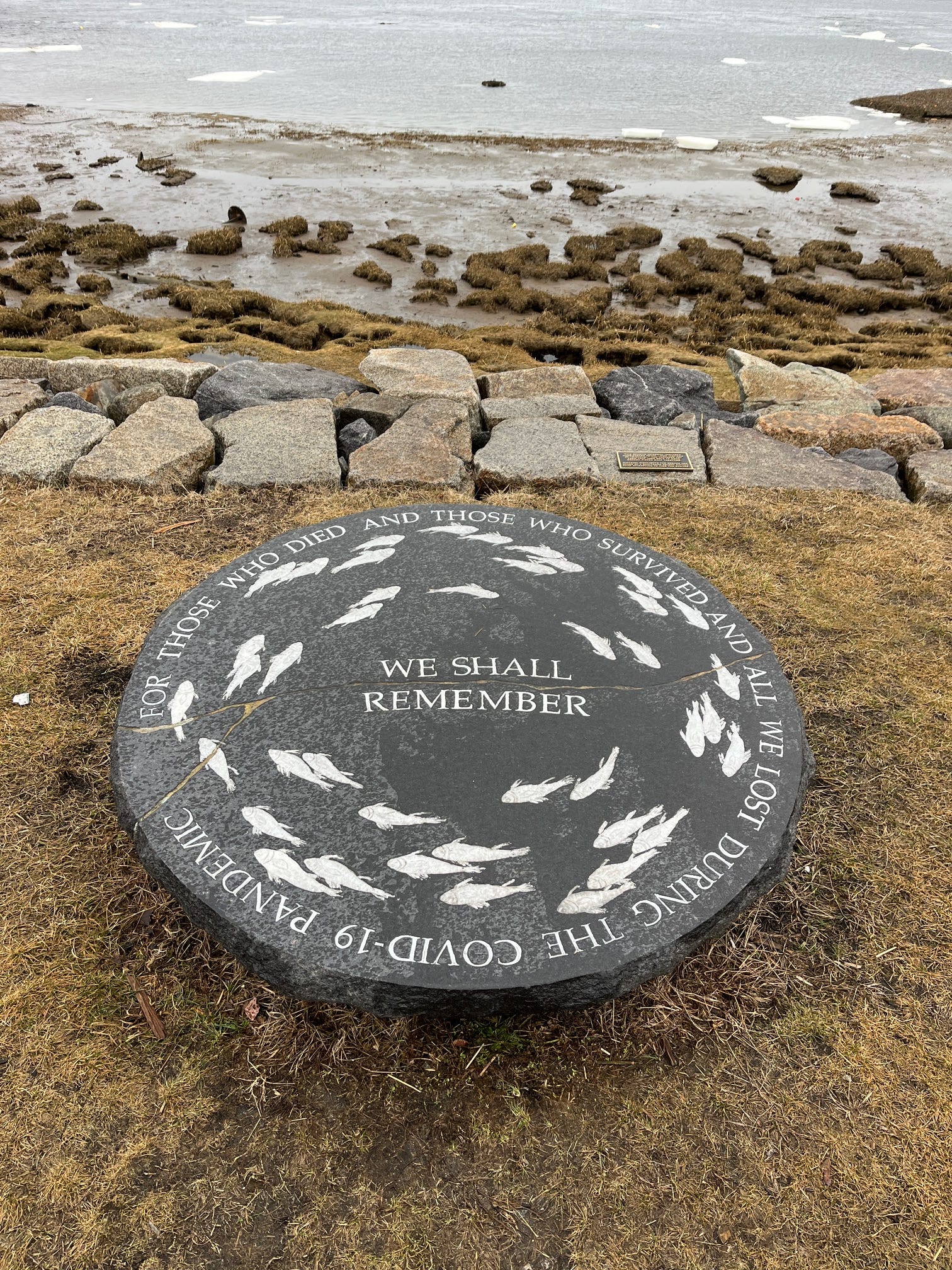
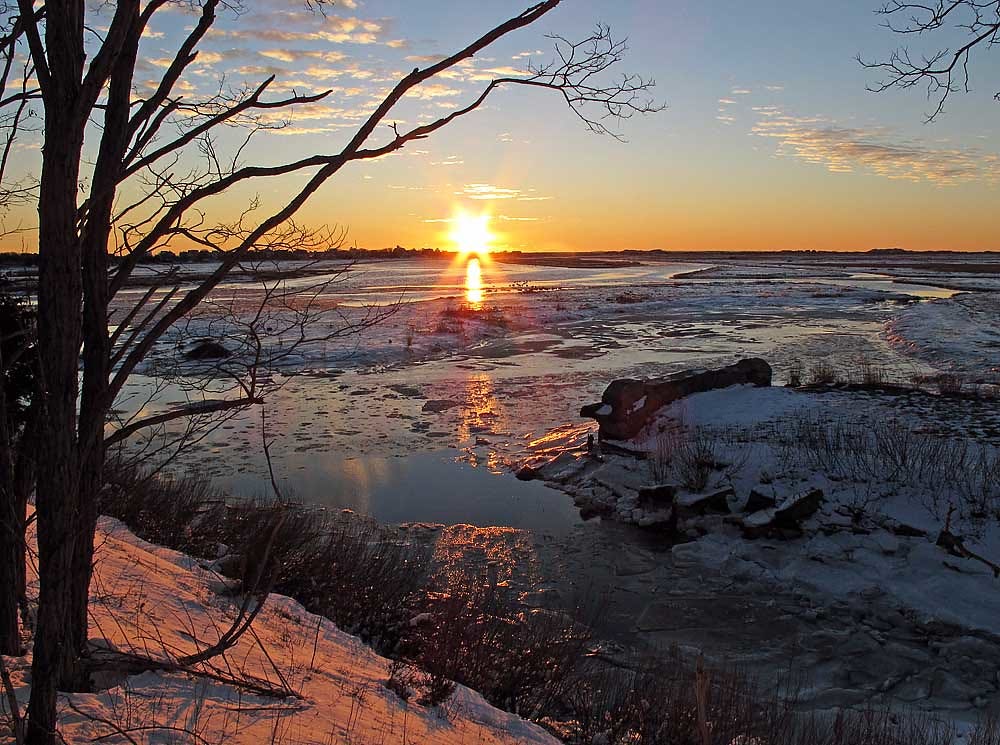
This pandemic memorial was installed on the Harborwalk back in 2023, after the worst of the crisis had passed. It was created by Michael Updike, a local sculptor and artist whose first intricate public project was the gravestone for his father, the author John Updike. It’s a beautiful sight in itself, but the surrounding landscape and the weather that afternoon amplified its power. The sky was the color of ashes and it was sleeting intermittently. Piles of rotten snow still dotted the grass nearby. But there was a faint warmth in the air—a tangible sign of spring. And just a handful of yards beyond the little white fish, swimming in their circles, Jorden and I watched the watery heft of the Merrimack River flowing forward, out and into the indefinite possibilities of the ocean.
Before our saunter, while toggling around various maps of the Clipper City Rail Trail, I had found a possible way to walk a much longer scenic loop around the Merrimack, on a patchwork of rail trails that run through Newburyport and nearby Salisbury. This loop walk would take the better part of a day, being around 13 miles in length, and it starts and finishes at the Newburyport train station—nixing a car from the equation! I had hoped to take the commuter rail back up there this coming weekend and spend some more quality time with Michael Updike’s pandemic monument and the nearby riverscape and wetlands, after a longer and more contemplative walk. Unfortunately, this past weekend, I slammed my pinky toe into the wooden leg of the couch at my apartment. And while I managed to avoid a bone fracture, I’m currently wearing a stiff soled surgical shoe and taping the little guy to his slightly larger neighboring toe. It’s an injury I’ve had before, and I should be back to walking and hiking in a week or so. But maybe you could get to Newburyport sooner; for a short walk, or the longer one.
It’s not often that a small piece of the landscape seems to offer a window to what a future could look like. But the Newburyport pandemic monument is in a league of its own. It is a depiction of our ability to remember and to continue living, with its white fish swimming around and around, and the flow of the Merrimack beckoning. Right after Trump’s re-election, I lamented the absence of a future that acknowledges the anxiety and immiseration that so many of us are still suffering…and how this deficit of vision made it easier for Trump to return to the White House, by promising the hellish inversion of such a future. As has always been the case, our job now—as a nation—is bringing that better, kinder, more humane and opportune future back into focus. The nightmare that we’re suffering at the moment won’t last forever. And when it ends, by election results or less conventional mechanisms, we’ll once again be presented with “looking backward” and “moving forward,” as if the two are binary, either/or choices.
The case for moving forward, without acknowledgment or accountability, has always been a way for politicians—and to some degree, the rest of us—to dodge the labor of doing both of these things. Making this mistake over and over again has brought us to this crux. For the good of our health, the next turning point should be different. It must include the space for recognizing what tens of millions have been forced to deal with since Trump re-entered the Oval Office. It must lead to prosecutions, for the laws that were broken. And it should bring us to a place of re-imagining what a real future can look like. Only then will we be ready to move forward, into something that can last.
CLICK HERE for a map of the 3.9-mile Clipper City Rail Trail walking route
CLICK HERE for a map of my 13.2-mile Newburyport riverscape walking route
I try to resist the temptation of using this newsletter to push my cinematic taste onto all of you too aggressively or frequently. But since the Oscars just went down, I want to use the footnote of this week’s dispatch to recommend one of the movies that was nominated for Best Foreign Language Film—not only because it’s my favorite movie from 2025, but because it involves walking through the landscape. That film is Sirāt, directed by Galician filmmaker Oliver Laxe, and the setup alone had me running for the nearest theater. A middle-aged father is searching for his daughter, who’s been missing for months, and he ends up at an electric music rave in the Moroccan desert (on the tip that she might be there.) He strikes out, but he also meets a small chosen family of nomadic ravers who are heading to another rave that’s even deeper in the desert. And that means another potential opportunity to find the missing daughter. But the desert is an incredibly harsh place, rife with elemental dangers. And to make things worse, a global war seems to be breaking out, just beyond the horizon line.
”Sirāt” is an Arabic word that describes a razor-thin bridge between paradise and hell. And that’s what the desert trip in Sirāt starts to resemble. Sometimes it mesmerizes, and other times it’s horrifying. But what sets Sirāt apart from other movies that have trafficked in merciless landscapes is its lack of nihilism. This movie is grounded in the idea that kindness is stubbornly persistent, even in the worst of times. Don’t get me wrong; Sirāt is an intense cinematic experience that had me periodically gasping. It stares at mortality without flinching. But when I staggered out into daylight, with the film’s techno beats still echoing in my head, I felt something that surprised me. Hope.
I agreed that Sirat was hands down the best film of 2025. I recommended it in my newsletter also but far less elegantly than you did! I do think the film absolutely needs to be seen in the theater. Love your work.